Monday, July 22, 2013

Morfontaine

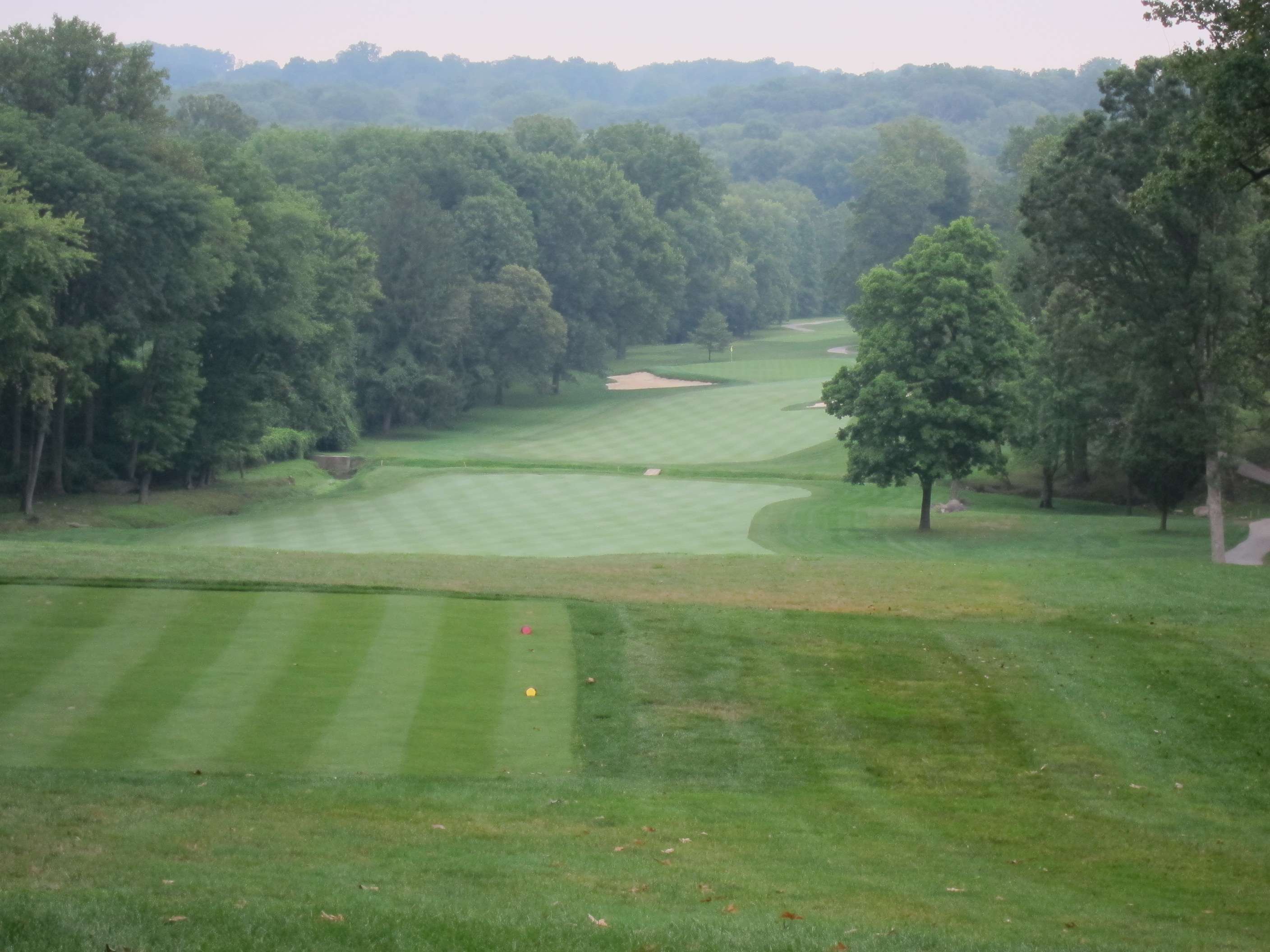
This picture of the 3rd hole from Darius Oliver's PlanetGolf.com website (pic by David Scaletti) sums up the many qualities of Morfontaine. None of my own pictures this time around, sorry.

Course name: Morfontaine
Location: Mortefontaine, Picardy, France
Four Word Course Review: A masterclass in restraint

I had the pleasure of spending a day at Morfontaine while revisiting my favourite country in the world, and it was as wonderful an experience as you might imagine.

I arrived about 9.30am to the same empty car park that others have experienced, played the main course, took refuge from the sun (36C and fairly humid that day) for lunch on the patio - during which a delightful older French lady endured my poor French for longer than she needed to to discuss how underrated French golf is and her grievances with President Hollande - before I excused myself to tackle the Vallaire course.

Playing alone, I had soon ripped through 27 holes and lunch in quick time, so I decided to play the main course again, despite being out on my feet from the heat.

It was great to play those remarkable holes again with an idea of the challenges that awaited and where everything was. I ditched the camera and range-finder for that second round and just played by feel with the occasional glance at a sprinkler head.

Hard to imagine a more perfect afternoon than playing that course in ideal condition - burnt and brown, firm and fast, the greens not too quick - without another noise than club on ball and ball on ground.

The Vallaire was one of the wildest courses I've played, and so much fun at every turn. The land and greens reminded me a good deal of what Ogilvy Clayton Design is doing at my home club, Bonnie Doon, in Sydney. As far as inspiration, it's hard to do better. Crucially, the greens don't just have a mass of bold shapes, they present a massive variety of pin positions that change greatly the way each hole plays.

The main course combines everything I love and respect about Tom Simpson's design work from New Zealand GC, County Louth and Hardelot (Les Pins) and takes it to another level. The green sites are perfectly selected, draped over the high ground more often than not, allowing the land to create the interest without too much intervention.

If I had to sum the course up in a word, it would be "restraint".

Simpson didn't build bunkers where they weren't needed - either on the drive or at the green. With such perfect land to work with at Morfontaine, there are countless examples where the land did the job without assistance and the course is all the better for it: the 3rd green, the 7th and 8th fairways, the lay-up at the 12th, the drive at 16.

Likewise, the greens are restrained. Where the Vallaire course is over dramatic land and suits the dramatic greens, the main course is for the most par on less heaving terrain. The greens still have enough to interest you and reward a perfectly-placed approach, but their virtues are less evident from a distance than on the Vallaire.

A perfect example of both the above factors is the first hole. The drive bends slowly right, off-camber around a heathery corner, with a drive on the inside rewarded by a clear run to the green. The land short of the green cants significantly toward the LHS greenfront bunker, making any shot from the outside of the dogleg progressively challenging - but also providing land that can be used by a skilled ballstriker to run a ball onto the front-to-back green.

So perfect is the balance of the course and detail of the features, it comes as no surprise that this is a course Simpson continually tinkered with throughout his life.

I envy those who get a lifetime to discover Morfontaine's secrets and delights, but feel fortunate to have had a day to play 45 holes and see just a little of what makes these two courses so highly regarded.

Friday, March 22, 2013

Healesville

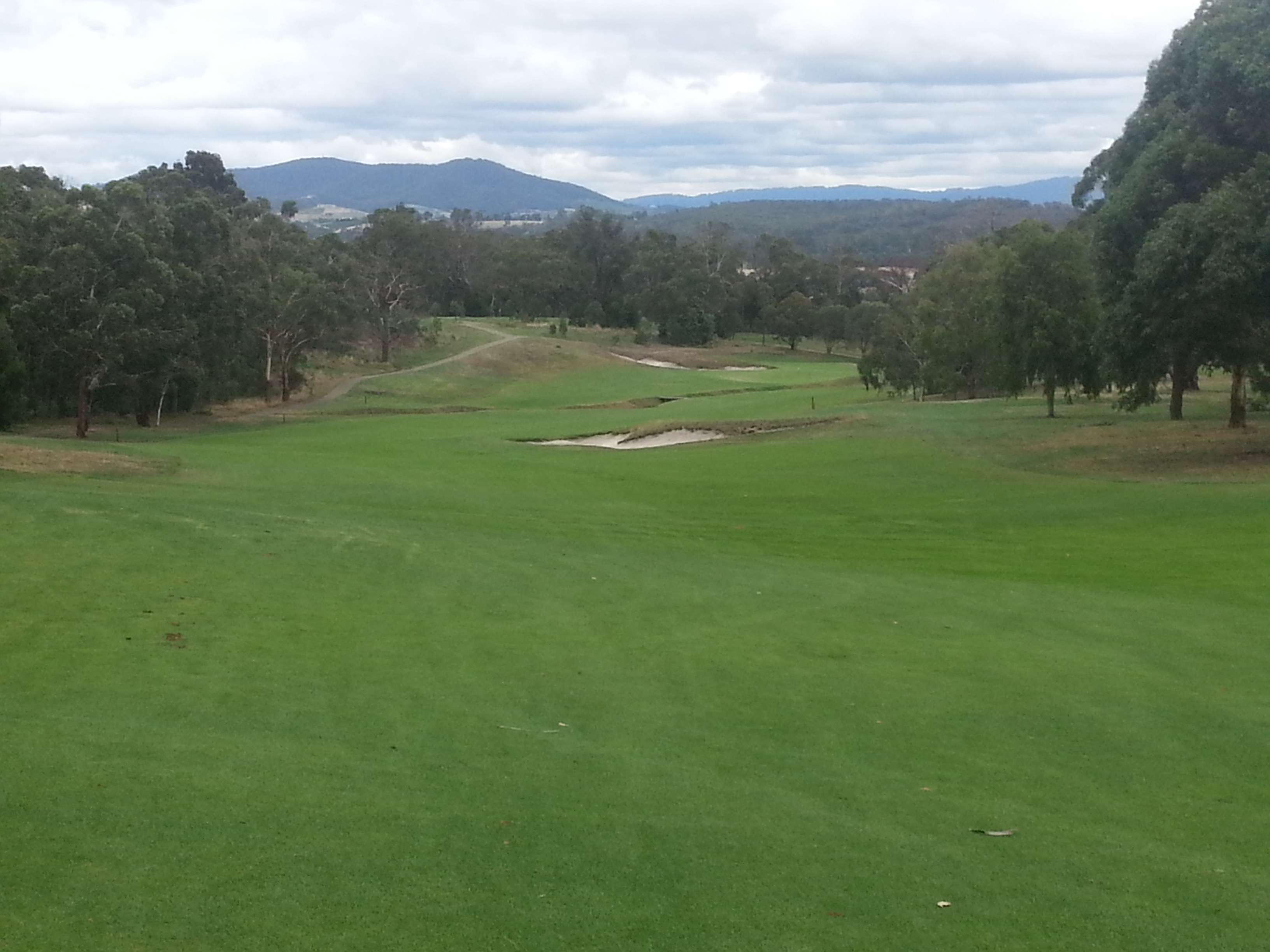
The fantastic par three 4th, which required a punched 18* hybrid for me, the ridge running lengthways through the green demanding accuracy and creating some interesting recovery shots

The long two-shotter at the 8th (labelled a par five, but driver, 6i from the tips for me) was the perfect length for the approach you need to hit. The green is cut in two distinct portions by a central ridge (reminded me a bit of the 5th green at The Lakes in that sense), with the hillside allowing you to work the ball in from the left to a front pin. The first great use of this creek, with it also utilised really well at the 15th and 16th

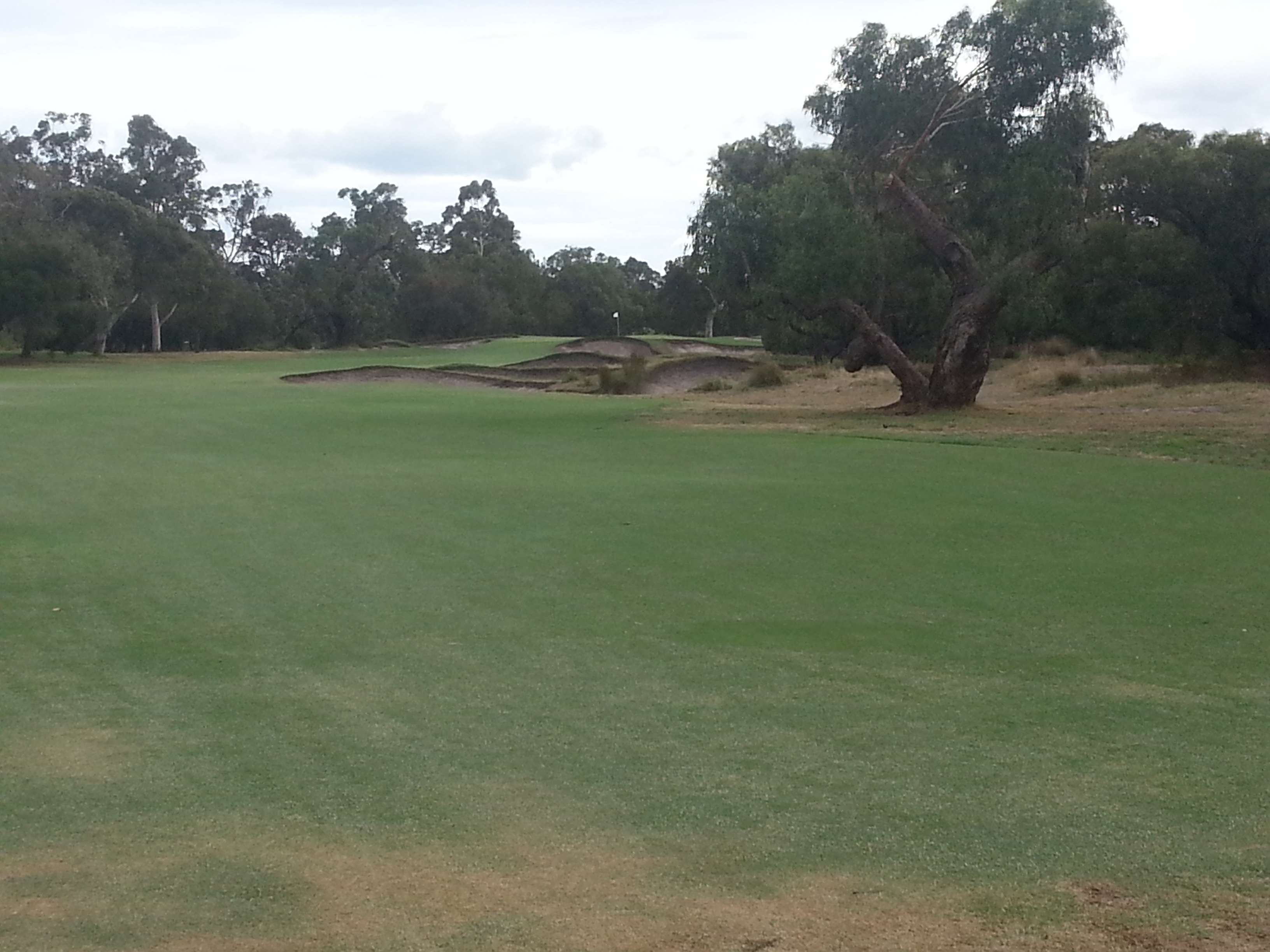
Gorgeous bunkering and a treacherous green on the par three 10th

One creek, three great uses: This meandering stream plays a strong role along the length of the 15th, before snaking over to spoon with the 16th green

Course name: Healesville
Location: Yarra Valley, Victoria, Australia
Four Word Course Review: No automatic two-putts

Healesville is just far enough out of Melbourne to feel like you've gone somewhere, but near enough that Melbournians can make a day-trip to enjoy one of the most brilliant new courses in Australia.

The course is really different to anything else I have played and has a strong character of its own.

It's owned by the Royal Automobile Club of Victoria and part of the club's Yarra Valley resort, but don't expect resort conditioning. It is unashamedly a country course, the rustic bunkering matching well with the "this is a playing field, not a formal lawn" conditioning.

The thought-provoking nature of such good golf at such modest length needs to be experienced.
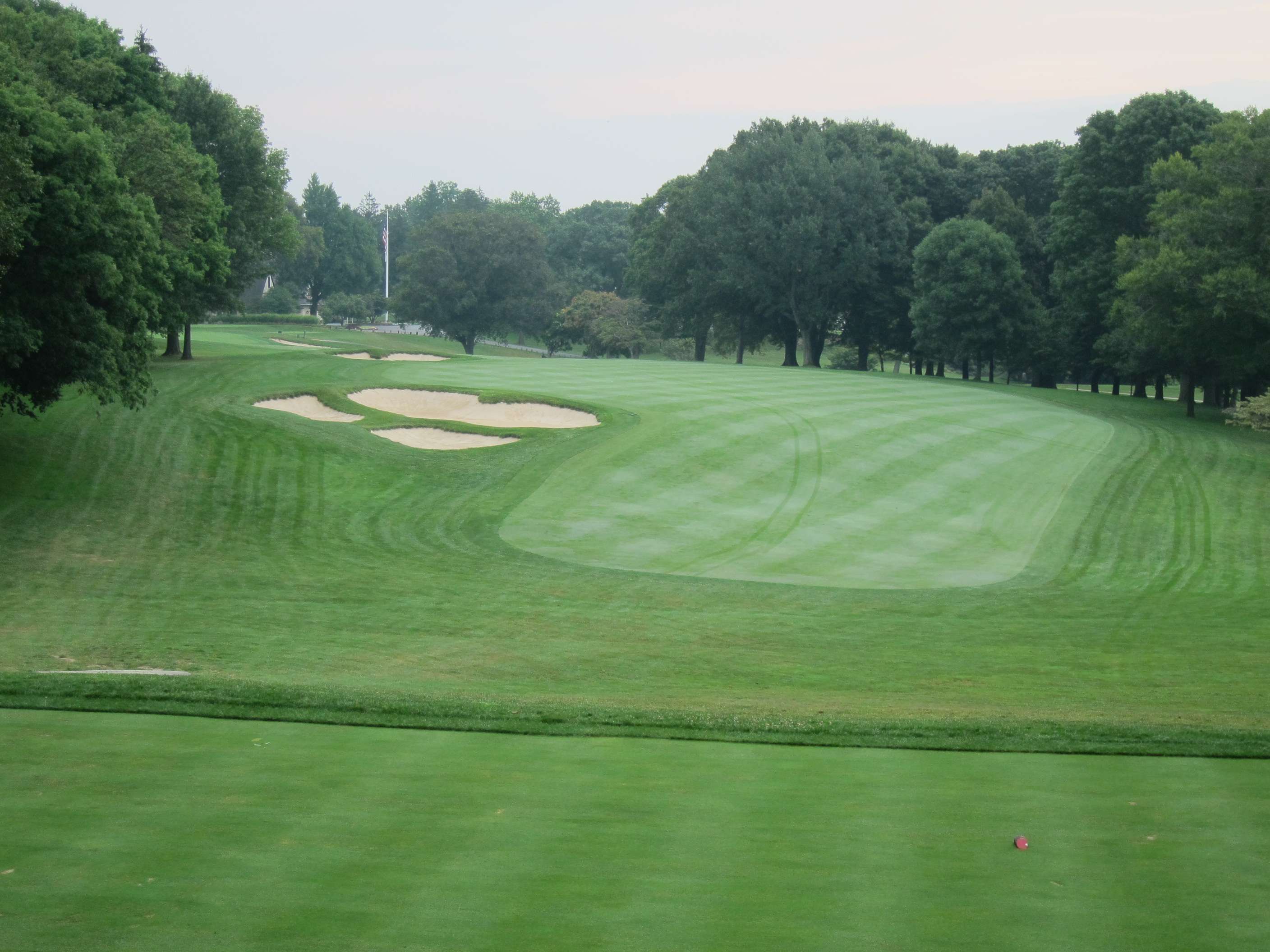
Like the value of immense width, the fact that such a short course can be THIS good has to be experienced to be genuinely understood.
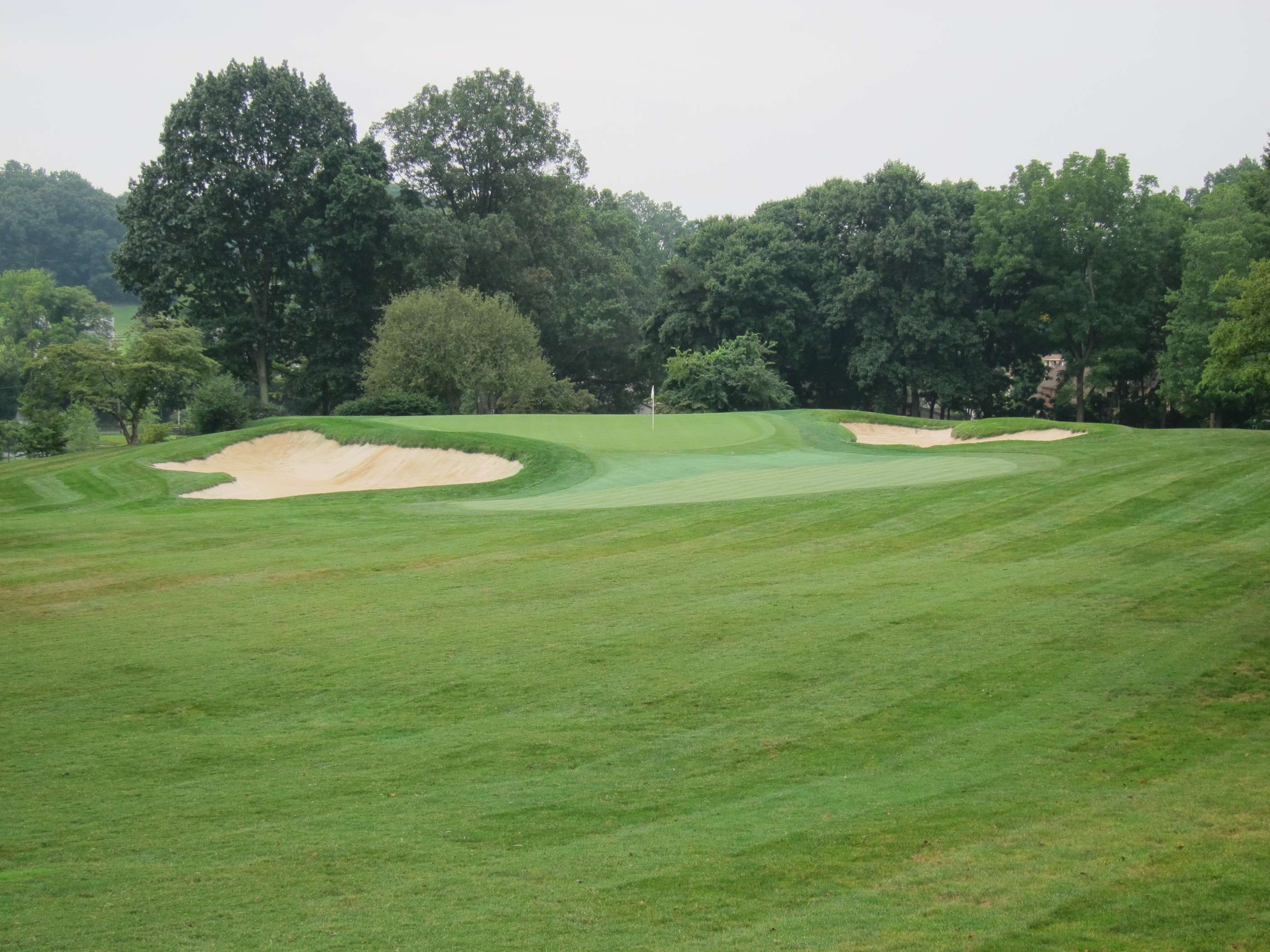
I couldn't help but think of so many cramped Sydney courses on similarly steep land and heavy soil whose members would be far better off with a 4800m (5300-yard) course like Healesville - full of shots and greens that put a smile on your face and which take a lot less time to play.
It's the greens that set Healesville apart: a set full of variety that regularly tiptoes up to the line of too zany, but never jumps over. They not only make approach shots, recoveries and putting all the more fun, they provide the teeth necessary to make the course challenging for all standards of golfer.

On the front side, I loved the long par three 4th, its green intersected by a steep ridge running from front to back, and the par-five-but-really-a-long-par-four 8th, which uses water and sand spectacularly and has a wild two-tier green.

The back side starts with an outstanding mid-iron par three with artistic bunkering that drips down the hillside on top of which the green is set, while the short par four 12th uses more brilliant terrain to create a puzzle to which the answer off the tee depends on the positioning of the hole.

Another angled creek adds value to the second-and-final par five on the course, where approaching the creekside green is made much easier by hugging the same narrow stream off the tee. The same waterway then cuts across to make your short iron to the 16th green one where distance control is at a premium.

The 17th's blindness from the tee is another case of the quirkiness that makes Healesville so beguiling, before the split fairway and ski-run green on the 18th finish this wild ride in appropriate style.

I can't recommend Healesville enough for anyone who wants to see something unique and doesn't view a tw-putt green as a birthright.

Thursday, March 21, 2013

Woodlands

Were it not followed by the all-world 4th, the short, dogleg-right 3rd would be more widely lauded...

...But sadly for the 3rd, the 4th is right there immediately after it, so hard luck - one of the best driveable fours in the game with a confounding green that I am sure it takes dozens of plays to unravel

Some of the best flat ground  bunkering on the sandbelt, and a great challenge for the mid to long iron approach you'll have at the 10th

I love the approach to the 12th, which makes it all the more lamentable that the drive is severely lacking

More great flat land bunkering makes the second shot at the 15th a lot of fun

Course name: Woodlands
Location: Mordialloc, Melbourne, Australia
Four Word Course Review: Dotted with highlights

Magnificent par fives and short fours and a memorable closing stretch are the standouts at Woodlands, with the best moments starting with the world-class driveable 4th and coming regularly throughout the round.

The 4th, just 251 metres, is so simple and effective and shows once again why length is overrated and why greens are to a golf course as a face is to a portrait.

The hole's quality is even more pronounced when you look at the non-descript land it occupies. You just have to try not to fixate on the gigantic tin shed over the road that mars the view from the tee!

After that early highlight, the three-shotters linger strongest in my memory, the 6th and 15th with rare second-shot interest and the home hole a magnificent green and perfect terrain.

The mid-length 7th and 12th holes have remarkable greens and bunkering, but both are less than they could be due to overbearing trees that choke the drive. An hour with a chainsaw could solve the problem and lift both holes greatly.

The 10th green, approached with a long iron or more, has more special bunkering (reminiscent of the 1st at Spring Valley) that looks great and makes a heap of sense.

The short par three 17th is by far my favourite of the one-shotters, with its smart bunkering and fun greenside chipping areas.

Downsides? The Melbourne Sandbelt is, for the most part, a lesson in getting the absolute most out of a property. The courses manage vegetation perfectly and have remarkable bunkering to overcome the fact that, for the most part, the terrain isn't all that impressive.

What disappointed me about Woodlands was that despite it having a handful of the best holes on the Sandbelt, the off-piste areas of the course transitioned almost immediately from the fairway to thick, unmanaged native vegetation.

I'd love to see the maintained areas transition more into the really thick stuff to reduce the time spent searching for balls that have scarcely left the fairway.

The inconsistency of Woodlands sets it back, along with the severity of the native, but there's no doubt that the course is home to a few of the best holes in Melbourne and has an uncommon amount of potential in it compared to many of its neighbours.

Sunday, December 09, 2012

Spring Valley

A good example of the course's fine presentation - the par three 5th

The attractive uphill closing hole

Course name: Spring Valley
Location: Clayton South, Victoria, Australia
Four Word Course Review: Gets the details right

Everyone should be so lucky as to call a course like Spring Valley their home and play it every weekend.

It has everything that makes golf fun - a comfortably walkable routing, interesting greens, ample variety and well-placed and sparingly-used bunkering.

It's the par fours that really stand out here, from the deceptively steep 1st green making a drive inside the dogleg a must, to the pushed-up green and great bunker pattern of the short 4th, smart centreline lay-up/foreshortening bunker at the lengthy 9th, awkwardly doglegging and off-camber 11th, tempting diagonal drive at the 16th and the visually stunning uphill approach to the 18th.

The attraction of wide open vistas is exhibited well at the 10th, 11th and 18th, which all sit in the same open plain, a few trees dotting the landscape for effect. Standing on the 10th tee (a tricky little drop shot par three to a green in a a sea of sand), it's hard to think of a more pleasant way to present a golf course (similar to the great vista over the 1st, 6th, 5th and 18th from the clubhouse at Kingston Heath).

The 10th mentioned above was my favourite of the one-shotters, but the long iron or hybrid required at the uphill 14th is another shot that lingers in my memory and I'll look forward to having another crack at someday.

Of course continuity is an important part of creating the best course you can, and some old features from previous architects around the course could be removed to make Spring Valley even better. Most notable to me where the rough-covered moguls right of the 12th fairway and overly-fancy shape of the bunker guarding the 6th green.

I love the way the course is presented, especially the fairway-height transitions from green surrounds to tees that blends the holes together and avoids an overly-busy look.

The lack of a handful of genuinely great holes is probably what keeps Spring Valley behind its most fancied neighbours, but by the same token it's also devoid of any real horrors.

Spring Valley might not get included in many visitors' Melbourne Sandbelt itineraries, but the powers that be at similar clubs elsewhere in Melbourne and around Australia would do well to pay a visit and see how doing the inexpensive little things right can make such a great difference to a course.

Friday, October 19, 2012

Durban

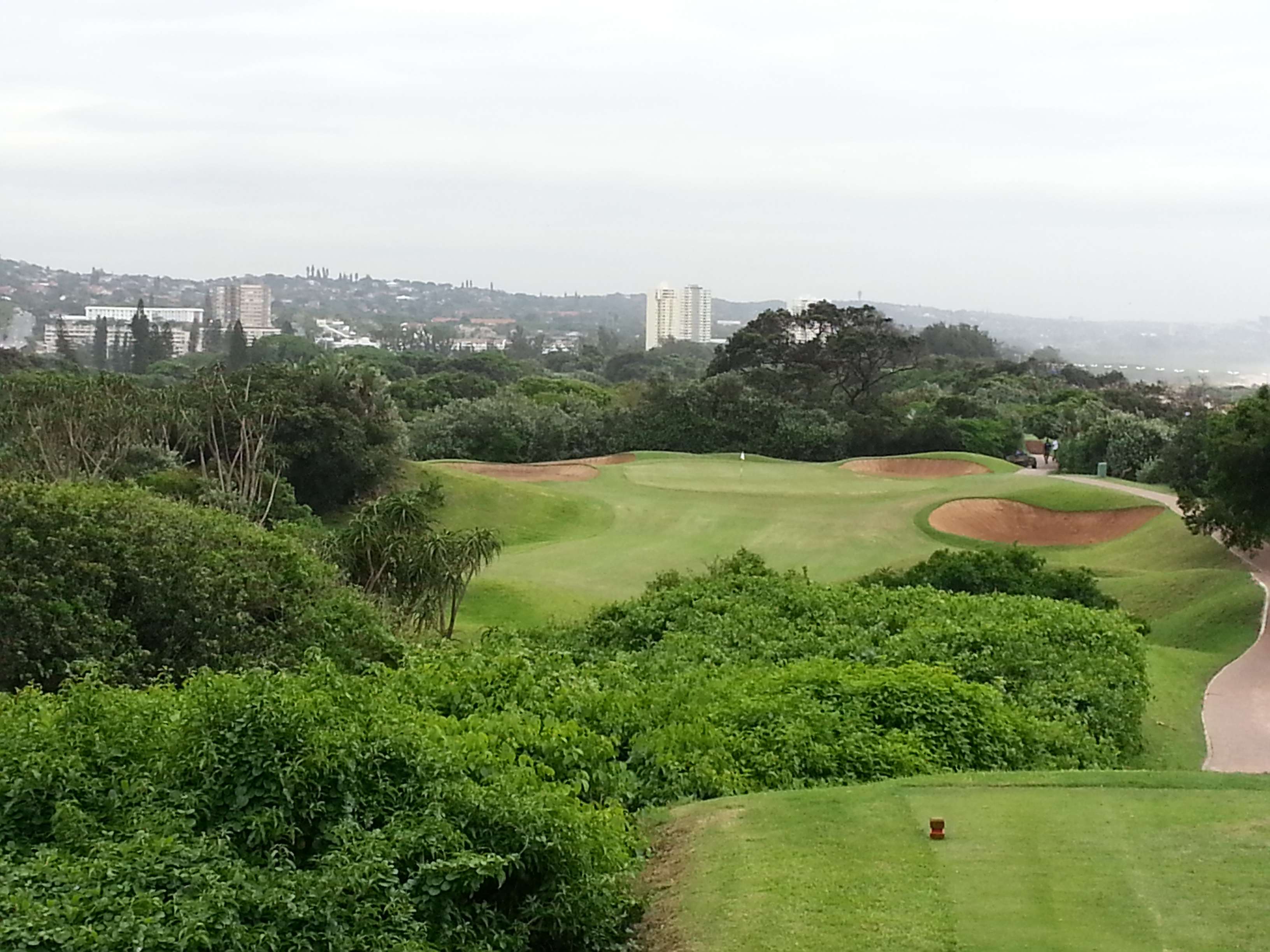
Expansive views from the 2nd tee and the dramatic rise and fall of the land around the green hides the reality of how steep the green is

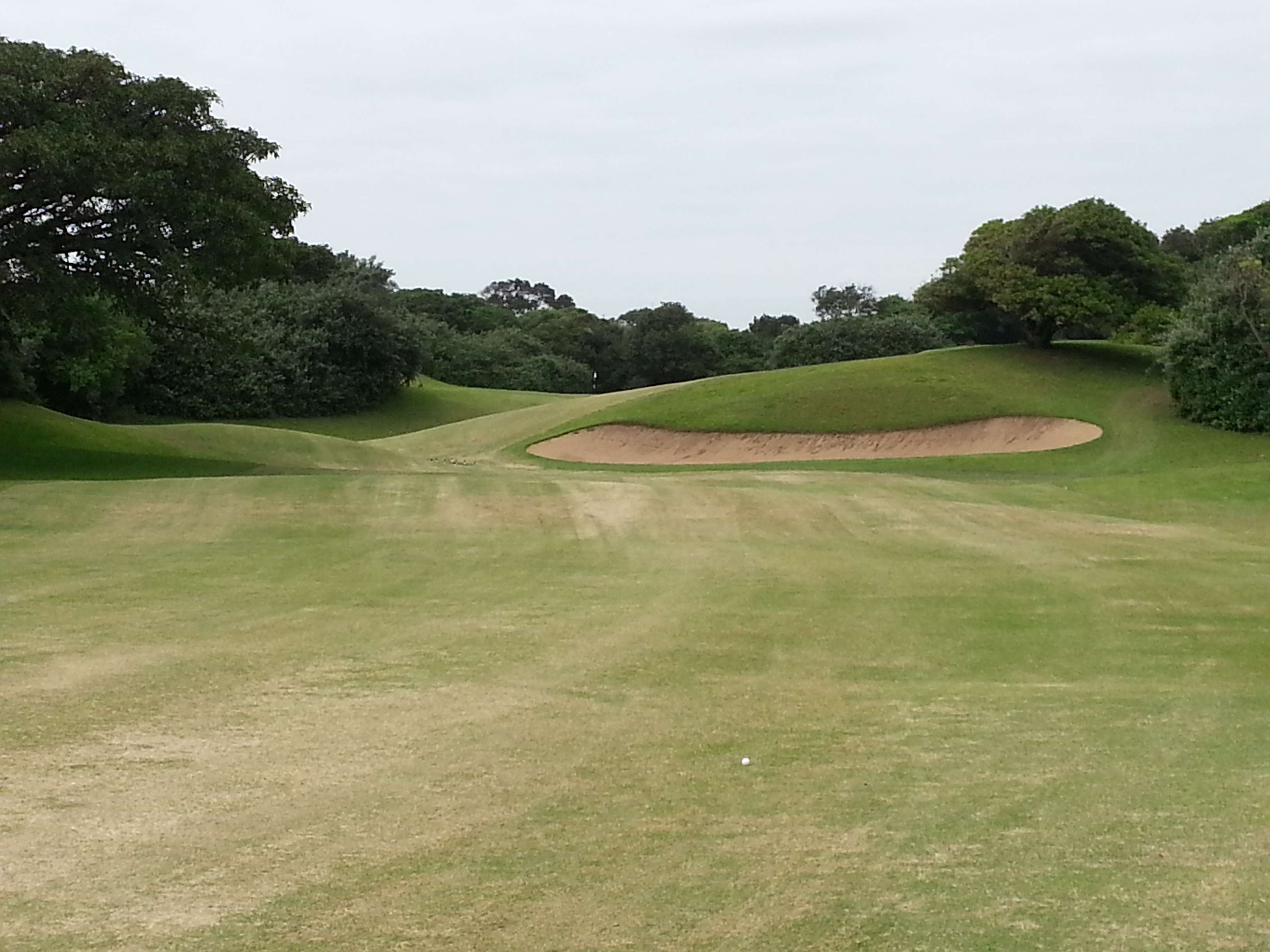
One of the bst long shots I have seen is the 200m or so in to the green on this short par five. The massive foreground bunker dominates the eye and obscures the safe ground between it and the green

There's nothing else quite like the 12th hole at Durban

The simple but challenging green of the driveable 18th


Viewed from behind (upstairs in the clubhouse!), the challenge and interest of the 18th is obvious

Course name: Durban
Location: Durban, Kwa-Zulu Natal, South Africa
Four Word Course Review: Stratospheric highs, subterranean lows

Playing Durban Country Club was always a goal of mine, so I made sure to set a couple of days aside during a recent trip to check it out.

Royal Melbourne (East) was always my barometer for hot and cold courses, but Durban CC leaves it in the shade in that regard.

It follows almost without exception at Durban CC that the good holes are on the good land and the poor on the flat land.

The best of the land is on the seaside east of the course and the southern area near the clubhouse (much of the front nine and the last two holes), while north and west, where the lion's share of the back nine sits, is plain and poorly used.

The undulations on the good land are extreme, with greens largely built on the high ground, maximising those landforms and ensuring you can't miss them.

The standout in that regard is the mid-length par four 17th, which plunges from a highpoint in the fairway to a series of ocean swell rolls before climbing up high again at the green. It's as dramatic as natural, traditional golf can get.

Two par fives on the front side - the 3rd and 8th - both occupy fantastic ground for golf, the former dropping from a high tee and the latter playing flat before rising to a well-elevated green. Both possess yawning fairway bunkers that both draw the eye and obscure what lies in the distance.

On the back nine, the unique short par three 12th - the famed Prince of Wales Hole - plays from one tall dune to another with the narrow green reaching all the way to the edges of the raised platform, meaning plenty of balls that land on the short stuff end up rolling down one of the flanks 25ft below the putting surface. If that's not tough enough, bunkers sit at the front and back of the green. I always thought the 17th at NSWGC was a severe short iron test in a high wind zone, but this is something else.

The last of the notables, the 18th is an extremely short four over some really fun land. Easily driveable, but if you take a straight line to the green you have to traverse a deep valley that kicks the ball right towards a steep falloff down to the driving range. The ideal shot is either a fade that lands on the higher ground and runs down to the green or a bold draw that flirts with the right before landing into the slope and running up the hill to the green. The putting surface is made by the flow of the central valley that runs naturally to a great right-hand side chipping area.

The vegetation management is a disappointment, with jungle so thick just off the fairways that going in to look for a ball is the definition of futile. Another let-down on the back nine is the removal of two epic fairway bunkers that would previously have made the par five 10th and 14th standouts on plain land, where now they lack something exciting.

With some judicious work, Durban CC could be a good two tiers better than it is and a worthy inclusion in the World Top 100, within which it nonetheless sits. Not many courses have as many breathtaking holes or such incredible land.

I highly recommend a visit despite the drawbacks. There's a lot to see that you won't see elsewhere and - my favourite thing about golf travel - you get to enjoy the game played a different way in a different culture.

Monday, October 15, 2012

Prince's Grant

Approaching the 4th is a delicate balance between getting over the false front and staying below the hole

Viewed from the back left, the 7th green's great flow is clear. While you can get home in two here, it's important not to leave too long a putt

A narrow ridge is used brilliantly at the 9th, where your drive has to tightrope walk down the right to leave you with a view of the green on approach

The climate north of Durban is extremely un-linkslike, yet the 10th hole is one of a few on the course that evokes thoughts of the British seaside

It's one hell of a good view from the 15th tee, but unfortunately the hole doesn't offer too much interest

A meandering creek creates tremendous interest to the second and third shots at the par five 18th

Course name: Prince's Grant
Location: Stanger, Kwa-Zulu Natal, South Africa
Four Word Course Review: Surprisingly engaging, memorable greens

In this internet age, it's rare to be completely caught by surprise when visiting a new course. There's just so much information and discussion out there.

But I had never planned to play at Prince's Grant, so anything I might have seen about it in passing didn't register. I set out early on a Monday morning with the intention of playing at Umhlali Country Club, but it was busy and there wasn't availability until later in the morning, so I drove across to Zimbali - a course within a residential and resort development - but they insisted that I had to take a cart and could not walk the course.

Returning home frustrated, a non-golfer relative said he had heard Prince's Grant was good, and at the very least that it was picturesque. I drove the half-hour to the course not knowing what to expect, but interested to see it.

Three hours later, I was stunned by what a fun set of greens the course had - making approach shots, greenside recoveries and putting a real highlight. Smart contouring that tied in with the design of the hole at large made placement crucial and there was immense variety from hole to hole.

Though the course is set within a residential development, the routing was for the most part extremely walkable - the only exceptions coming from the 2nd green to 3rd tee and 3rd green to 4th tee, both of which involved trekking along residential streets, through a cookie-cutter neighbourhood that looked like The Truman Show could have been filmed there.

Accepting that those sorts of compromises are part and parcel of this kind of golf course, it was good at least to get that out of the way early in the round.

The front nine offers some early highlights - a drop shot par three at the 3rd with a wild "speedbump" green, the uphill approach to the 4th green with its false-front staring back at you and the par five, three, four stretch of the 7th, 8th and 9th each using some dramatic land in different ways: a Biarritz inspired green, a tough benched one-shotter and a rollicking fairway.

The back starts and finishes strong with the linksy par four 10th and exposed ridge-top par three 11th, intimidating long par three 17th and par five finishing hole that makes great use of a creek beginning in the fairway before wrapping around the green.

Width is generous throughout - a must for such a windy site - which ensured even when the breeze reached three clubs in strength late in the round every hole was comfortably playable.

Sunday, August 19, 2012

Pasatiempo

The short bunker at the 4th creates a partially blind approach against the angle of the hill for anyone who fails to drive down the more risky right-hand side


From the tee, you can't imagine how steep and treacherous the 5th green is


The approach to the 11th

14th fairway is like nothing I've seen ever before. The best bet is to drive your ball as close to the valley as possible without trickling down

Awesome 16th - note how the bloke in the bunker provides some idea of just how deep it is in there!


I'd love to see more courses break with convention and present an out-of-the-box 18th hole

Course name: Pasatiempo
Location: Santa Cruz, California
Four Word Course Review: Deserves much more adulation

Having waited seven years to get to Pasatiempo, I arrived early enough to walk around the famous closing holes before my round - not knowing when, if ever, I might return and wanting to make the most of the experience.

It was early enough that no golfers had reached the turn, so it was just me and a couple of grounds staff on the back nine. I walked out past the 18th green, stopping to get my head around such a unique closing hole, and then headed off down the path that separates the 10th and 17th fairways.

From beyond the 10th green, I turned to get the panorama of the incredible three-tiered 16th green (a gentleman raking the front trap providing welcome scale as to just how cavernous it is) and 11th fairway flanking, then crossing, the barranca and ultimately reaching the hilltop green.

Much like when I first visited Royal Dornoch and felt a strange spirituality sitting on a bench by the 1st tee overlooking the deserted links in the late evening light, there was something about the moment unlike what I usually experience on even the best golf courses. I sat for a while on a bench near the 11th tee to take in what I was finally laying eyes on and try to make sense of what caused such a rare feeling.

In hindsight, both Pasatiempo and Dornoch were places I dreamed about and imagined at great length before ever visiting and my first encounter with both was in that magic time within an hour or so of sunrise or sunset. Perhaps not surprising, then, that the elation of being there combined with the beauty of the time of day combined to create such a special moment.

While Dr Alister MacKenzie created a handful of courses more famous than Pasatiempo, it is said there was no course more dear to him than Pasatiempo, which he lived alongside from its conception until his death. In that moment, I could easily understand why.

As well as the legendary 11th, 16th and 18th - I was stunned by the unique fairway of the 14th hole dissected by a Y-shaped depression, the artful bunkering of the barranca-flanked 15th green and the simplicity of the downhill two-shot 12th - another hole to make use of the barranca.

Back to my car to grab my clubs and begin the round, I had to pinch myself setting out onto the front nine - blink on the first few holes and your card could be wrecked and some great holes could be glossed over.

The 2nd green uses a hillside brilliantly and the long par three 3rd is a beautiful brute.

The clever 4th hole sums up that beyond the obvious drama of the land and beautiful bunkering, Pasatiempo hides preferred lines beside and beyond hazards as smartly as any course of MacKenzie's and utilises the more subtle rises and drops in land to create some partial blindness when you misdirect a drive.

Green speeds must be something the superintendent keeps a daily, if not hourly, eye on. Many are so steep and boldly contoured that at too great a speed they'd become un-puttable. The 16th is a poster child for that, but the par threes 5th and 8th are just as "on the edge" - and at the speed I encountered them, a heap of fun to chip to and putt on.

Passing MacKenzie's home near the 6th green was fantastic, it's just a shame the adjoining holes - the short par four 7th especially - have been hamstrung by the tree plantings necessary to improve safety on that tight area of the course.

Pasatiempo doesn't get the attention or love it deserves. Few courses have as many great holes, few courses have so many unique and special features, few courses are as beautiful without relying on external views and few courses possess as many shots that put a smile on your face. What more could you want? Get there immediately.

Friday, August 17, 2012

Pine Valley (Short)

The opening hole on the Short Course replicated the famous 10th at Pine Valley, complete with mini Devil's Asshole!

The approach to the main course's 13th hole is recreated as the 7th hole of the Short Course

The best is saved for last - it's uncanny how similar this recreation is to the actual approach to the 2nd green 

Course name: Pine Valley (Short)
Location: Clementon, New Jersey
Four Three Word Course Review: Perfection's little brother


What does a club do when it already has the best greatest golf course in the world and a hundred acres to spare? Build a few of the best holes again!

There was never any point in Pine Valley Golf Club supplementing its World #1 course with another 18-holer, but this 10-hole course is the perfect way to prepare for, or relax after, your lap around the main course.

Pine Valley's Short Course is a genius concept - take some of the best shots from the finest golf course in the world and replicate in a condensed series.

It gives you one more chance to tackle the approach shots to the 2nd, 13th ,16th, 17th, three of the par threes (3, 10, 14) and the final two-thirds of the most difficult hole I've ever come across: the par five 15th.

What's more, approaching the greens that replicate par fours and fives is done from the same awkward lies you find on the big course and without the use of a tee.

As well as those facsimile holes, the 4th and 9th holes are originals by course creators Ernie Ransome and Tom Fazio.

As a further benefit to the club, the Short Course provides an opportunity for new or different greenkeeping practices to be carried out on "in play" holes within the same environment without taking risks on Crump and Colt's masterpiece.

Tuesday, August 14, 2012

Lancaster

The 2nd green takes advantage of a commanding position

The 8th hole is reminiscent of the 14th at Rolling Green, but boasts a more spacious location

A deceptively steep back-to-front slope makes the 17th tougher to par than it might immediately appear

Course name: Lancaster
Location: Lancaster, Pennsylvania
Four Word Course Review: Amish golf (simple & traditional!)

Ninety minutes out of Philadelphia, Lancaster CC has one significant advantage over the courses in the city - an expansive site in rolling hills with longer views.

That more generous setting creates a real feeling of expansive scale to the land over which William Flynn routed a course that twists and turns on itself with surprises around every corner.

Like at Philadelphia’s Rolling Green, Flynn showed himself at Lancaster to be a master of using steep land - creating holes that encounter the hillsides from all angles and taking advantage of the really steep stuff to set up dramatic shots like the drive across the river at the par four 3rd and the ridge-to-ridge par three 8th.

Lengths vary greatly, but short par fours such as the 4th, 5th and 16th are full of challenge thanks to the great use of land and smart hazard placement.

And where the land hasn’t got its own magic, smart green placement makes the likes of the skyline 2nd and riverside 7th genuine highlights.

The result is a course that peppers you with a series of new challenges while retaining a collective character that ties the holes together. The warm, welcoming club is an added reason to make the drive to Lancaster - the post-round drinks and meal overlooking the course as afternoon slipped into night remains a lasting highlight of my time spent travelling in America.

Rolling Green

No time wasted up front, the opening tee shot is one of the most thrilling on the course, the fairway increasingly deflecting your ball sideways the further right you go

Old photos show a vastly different LHS bunker - the larger renovated bunker creates much better scale and draws your eye away from the green

The creek adds interest to your drive at the par five 7th and the approach is well-bunkered to make you question going for the green in two

Who says uphill par threes can't be great holes? The defense presents the 10th at Rolling Green

Playing from ridge to ridge over a steep valley, the 14th is a monster. Next time I'll probably lay up

Course name: Rolling Green
Location: Philadelphia, Pennsylvania

My home town of Sydney has a heap of steep terrain, particulalr in its northern suburbs. Sadly none of the courses in that area had William Flynn involved in their creation, or they'd be a hell of a lot better than they are!

That thought returned to the front of my mind time and time again as I toured Rolling Green and saw the innovative ways Flynn got the best out of steep terrain by finding smart greensites and avoiding some genuinely unusable land by siting par threes from ridge to ridge.

Despite the limited ways to use such land, the course is loaded with variety and the putting surfaces work with the natural fall of the land, creating a set of greens where contour is only used where the green is on flatter ground, such as at the par five 7th.

The par threes were the highlight for me, with a recent bunkler renovation adding to the drama of the mid iron 3rd, natural drapery of the uphill 10th and the drama of the cross-canyon 14th.

The par fives also stand out in my memory: a well-placed creek and fun greensite at the 7th, the challenge of the marathon 9th climbing a steady hill for more than 600 yards and the tumbling downhill-then-uphill 18th.

There’s nothing flashy about Rolling Green, just smart use of steep land to create a course that keeps you entertained and engaged the whole way around.

Monday, August 13, 2012

Glen Mills

A centreline bunker at the 2nd hole rewards a drive that hugs the more challenging left-hand side

A man-made quarry that comes into play whether laying up or going for the green makes the par five 4th such a standout

Though shorter than most Redans, the 14th retains many of the features that make the original hole and its imitators so fun and interesting

Course name: The Golf Course at Glen Mills
Location: Glen Mills, Pennsylvania
Four Word Course Review: Worth seeing for highlights

I generally pay little attention to the particulars of a club attached to a course when considering its merits, but in this case Glen Mills' standing as part of a reform school giving troubled teens a final chance before prison gave me an extra good feeling in paying my green fee and heading to the first tee.

Golfers often celebrate the game's ability to build character and networks and I can't help but feel the game's lessons are the sort of thing an off-the-rails teenager could use in their life.

The course opens with a pair of strong dogleg left par fours, the 1st with a fun downhill approach to a bold green and the second using a smart centreline bunker that obscures the green to encourage a brave drive down the left.

The 4th, ending a fine opening stretch, is a clever par five utilising a faux quarry to build excitement and interest into the second shot.

That run of holes is set in an open parkland that, along with the surrounding countryside and building architecture, had me feeling like I was back in southern England.

The second half of the front nine can't match those early heights, but the long iron or wood shots at the par three 7th and into the par four 9th green are highlights.

After an extreme drop shot par three at the 10th that is probably too extreme, the back nine has standout moments at the short par four 12th, Redan 14th and par five 15th with its Biarritz green.

The testing final hole is another example of how this course at its best is a thrill, but when it gets too tight - as it does in stages on both nines - it's a joyless slog.

Glen Mills is definitely worth playing, it's just a shame the tightrope 6th, 11th and 17th holes couldn't have some greater width and the par three 5th, 10th and 16th lack the feeling that they do more than connect longer, better holes.

Saturday, August 11, 2012

Sand Hills

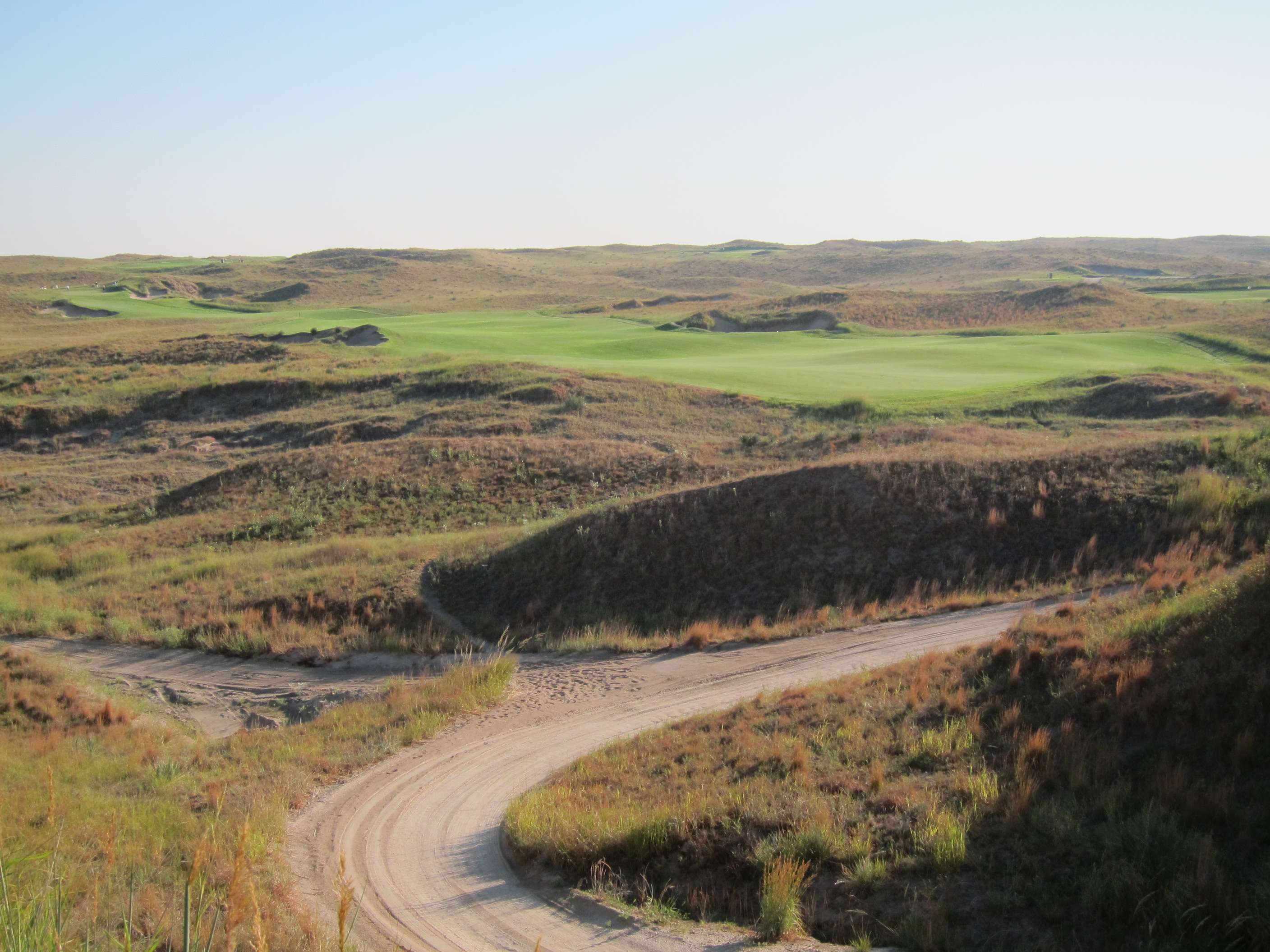
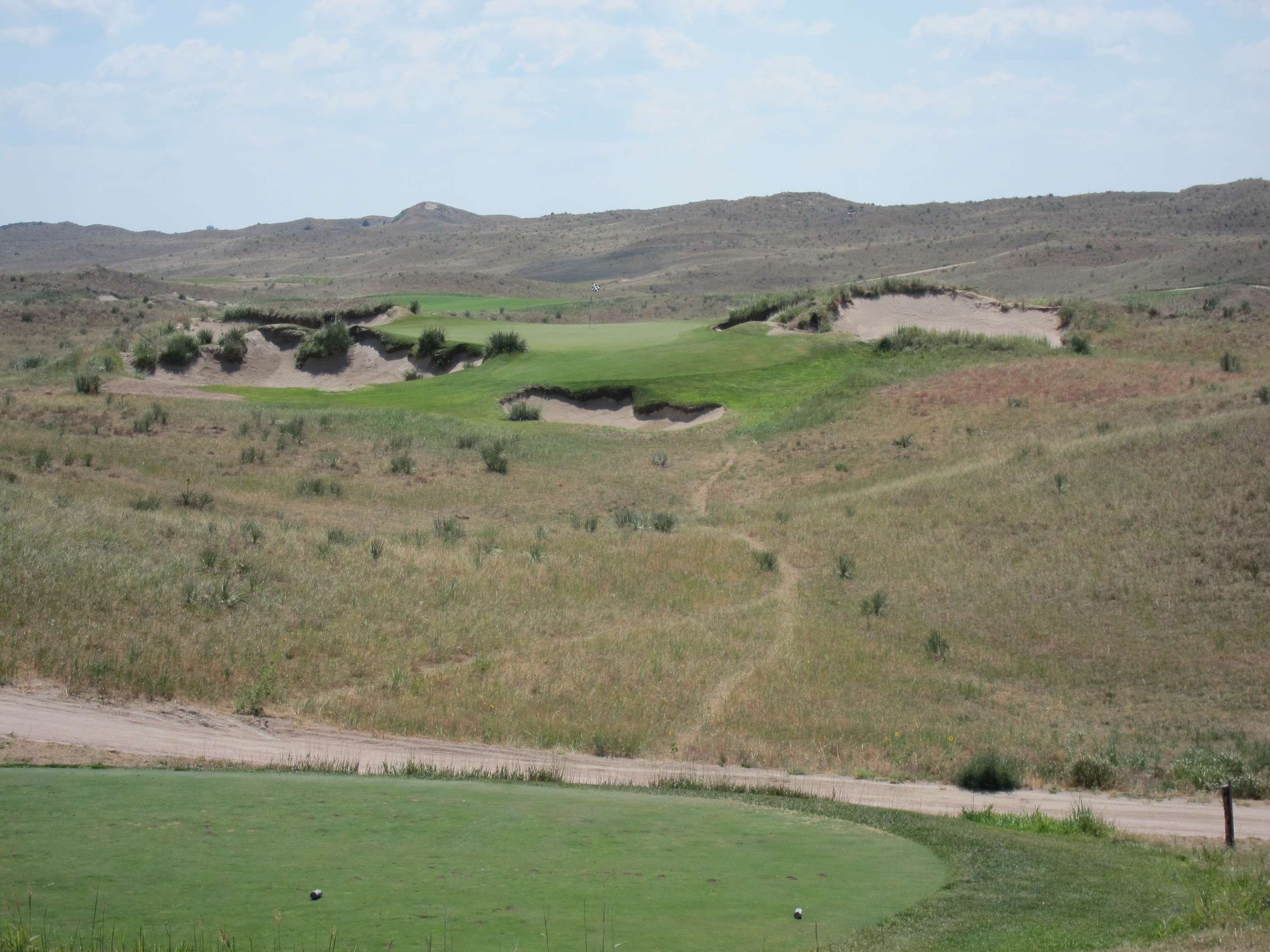
The view from the 1st tee sets the tone for the great golf and breathtaking landscape that awaits around every turn

The 2nd green slides off a hillside at one boundary of the course, overlooking a few hundred more acres of ideal golf land that explains how Coore and Crenshaw were able to discover a good few hundred possible holes here before settling on the 18 they built

The 4th hole proves just as interesting and fun to play down gale as into a howling wind, true elasticity

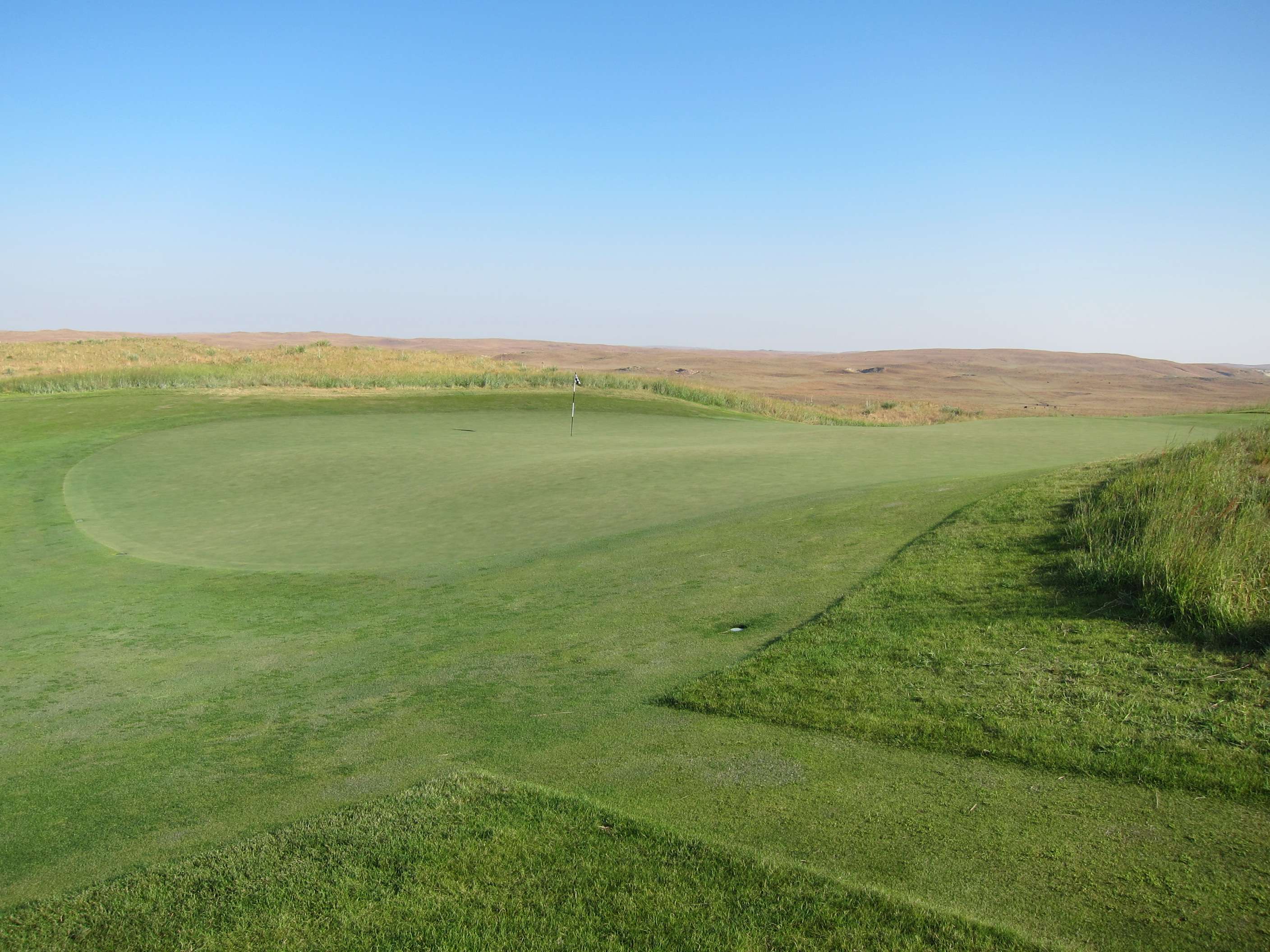
At the 5th green, a small ridge creates plenty of putting interest and rewards the most accurate of approach shots

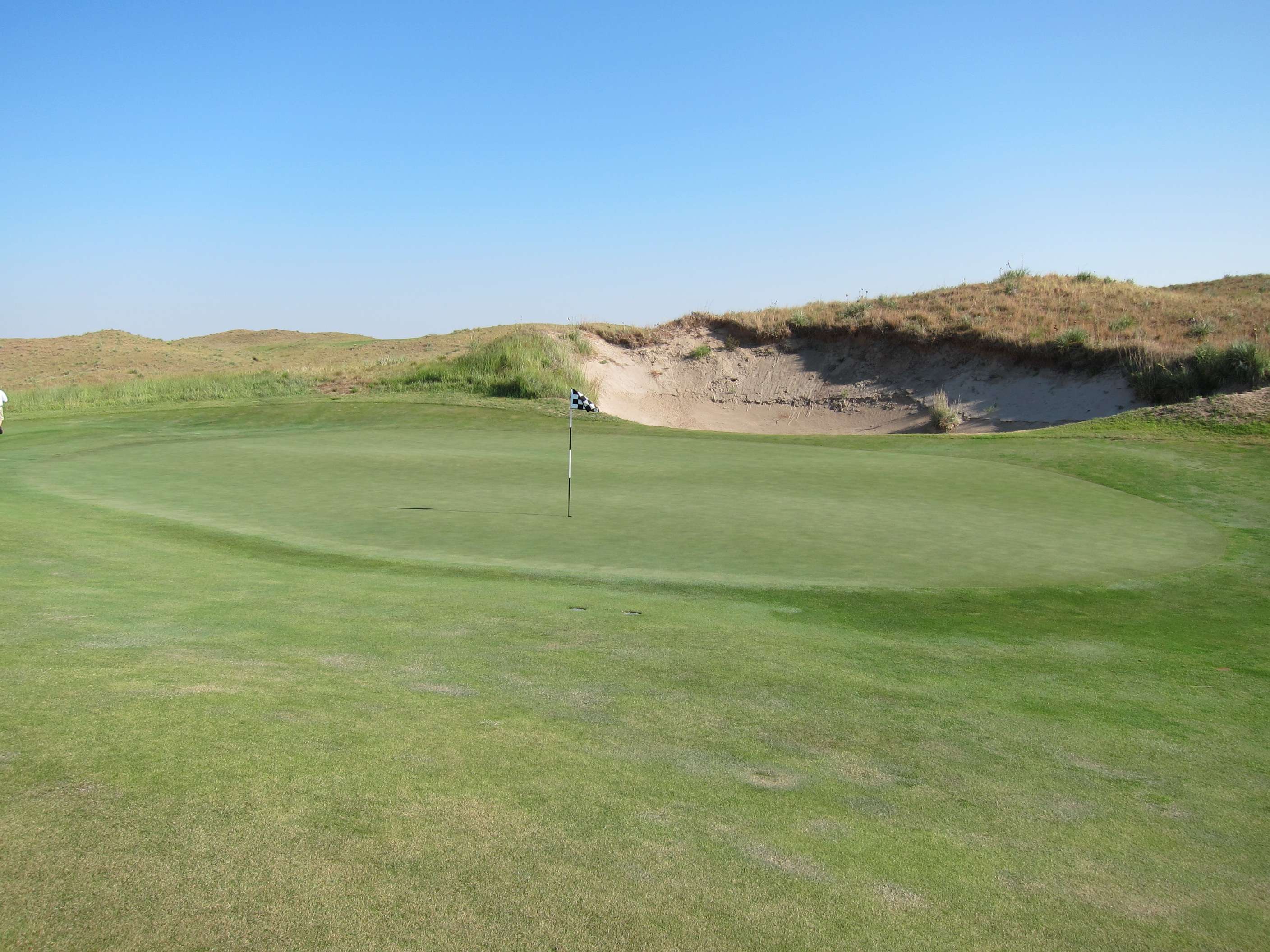
The 7th green's slope away from the bunker makes any recovery from the sand exponentially more difficult

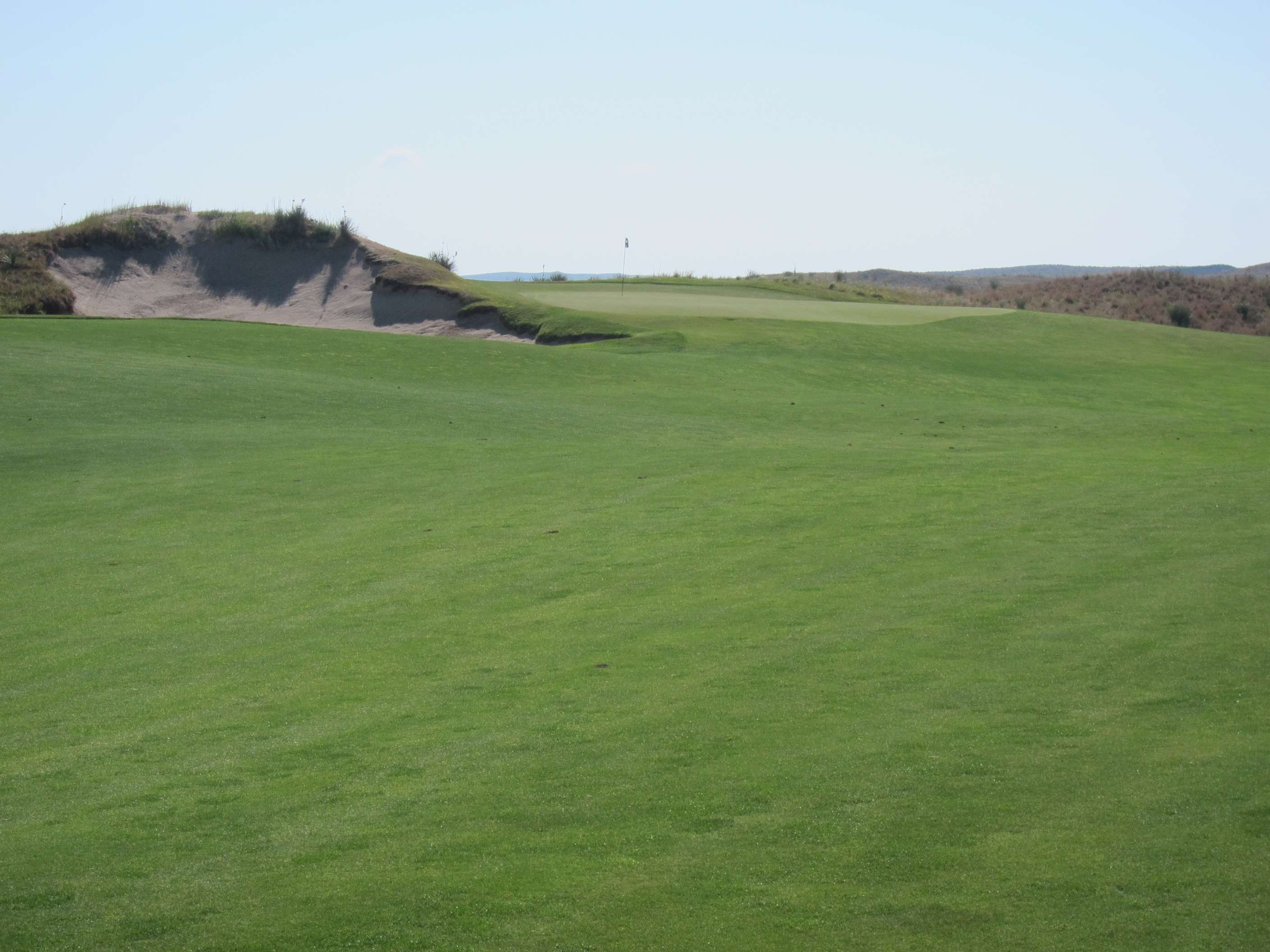
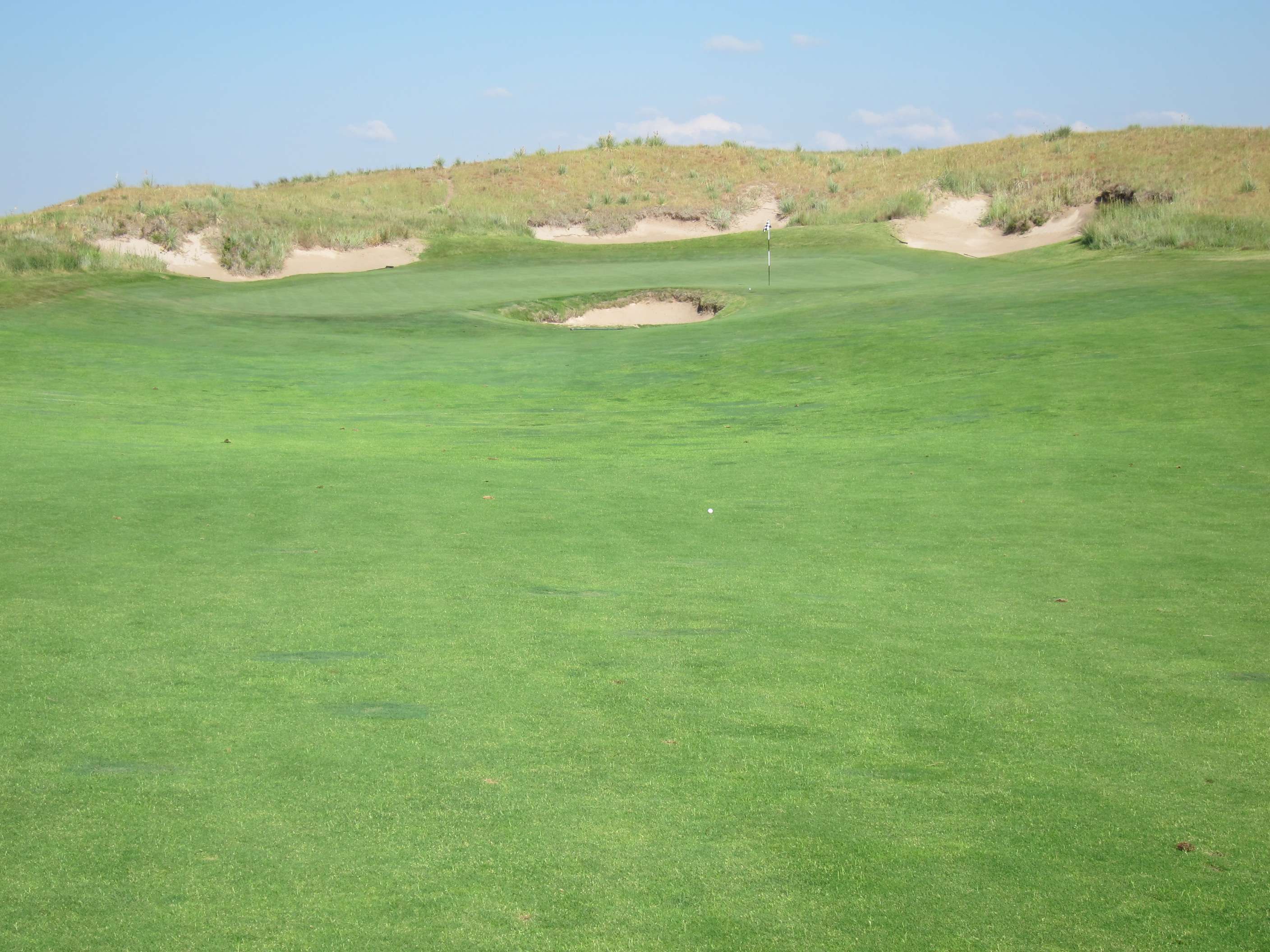
The 8th hole is a standout, largely because of the greenfront bunker that changes the preferred side of the fairway depending on the pin position and also adds some extra framing to the amphitheatre green

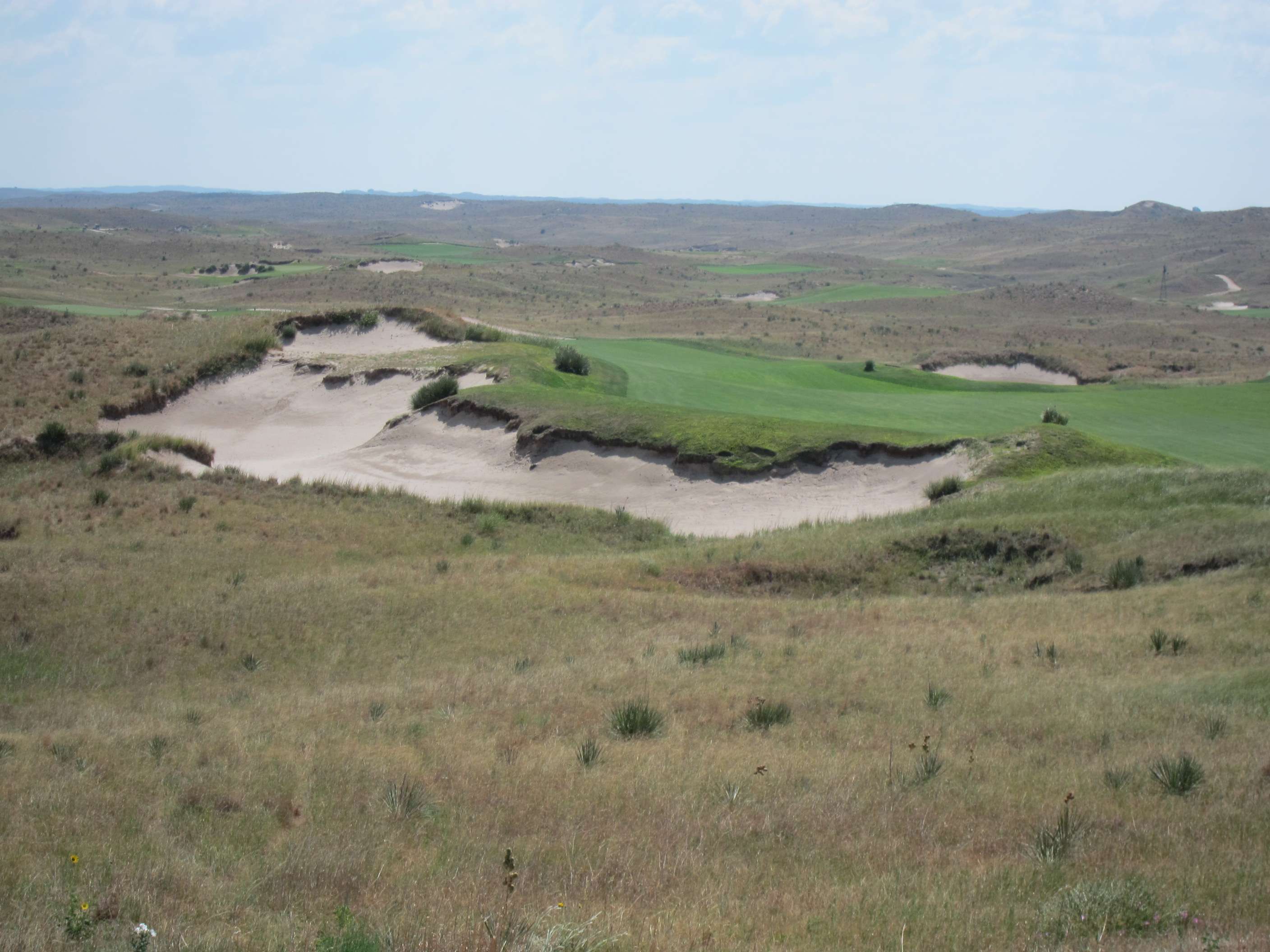
This bunker at the 16th is an example of the bold drive bunkers at Sand Hills

The majestic 17th hole

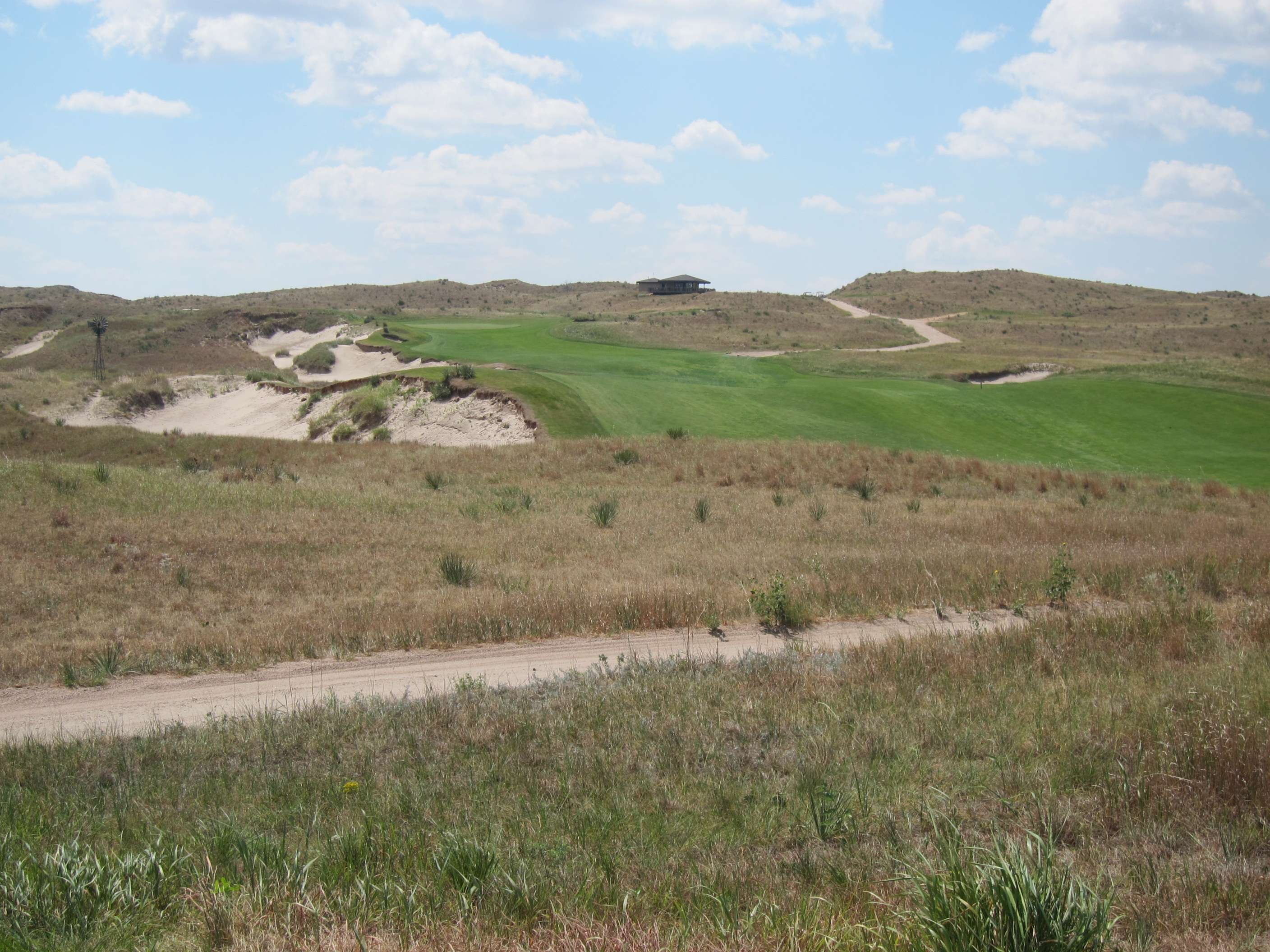
A long par four closing hole is most fun played from the back tee, tucked way to the left so the massive drive bunker must be encountered rather than bypassed

Course name: Sand Hills
Location: Mullen, Nebraska
Four Word Course Review: Post hoc, propter hoc

It only takes one walk around Sand Hills to understand why it inspired a new generation of golf architects and developers to build great courses free of unimportant excesses.

The way the land, bunkers and greens combine to create a series of intriguing holes is evident as you play, but looking across the course from Ben's Porch (behind the 9th green) or from one of the property's high points, you see how the small features that make the holes flow into the large landforms that give the site its interest.

The story goes that Bill Coore and Ben Crenshaw discovered all bar one of the course's bunkers (that short of the 8th green, which makes the hole such a highlight), before shaping the rough expanses of sand into bunkers that evolve daily as the sand is blown around and out of them. Even if that's a slight embellishment, the way those bunkers snuggle into dunes and ridges gives the impression they were crafted by the wind, as the bunkers of the very first golf courses were.

The bunker that generates the most discussion is the cavern short left of the 4th green that's deeper than a drunk poet and bigger than Rhode Island, but fondest in my memory is the diagonal sea of sand at the 15th, inviting you to steer as far to the right as possible for a better shot into the domed, false-fronted green.

A similar bunker makes the finishing hole so much fun to play (especially off the back tee that maximises the dogleg), while a large bunker that hugs the front left of the short par four 7th's green, with the putting surface sloping away, creates wildly divergent strategies depending on wind and pin position.

Equally significant in the course's quality and feeling of simplicity are the greens - most of them using natural slopes and simple features to create interest.

The subtle tilt of the 7th green is an example, as are the false front and side-by-side tiers of the 2nd green, lengthways ridge in the 5th green, domed 9th and skyline 11th putting surfaces and sidehill 16th green.

Most impressive having played the course in strong winds that saw the 4th require a four iron approach one day and half a gap wedge the next is that every hole was just as playable in one wind as it was in the other, and where consecutive driveable par fours at the 7th and 8th might seem odd, by playing in opposite directions you'll always have a good chance of driving the green on one and will have to formulate a smart drive-and-pitch strategy on the other.

The routing, taking advantage of a large bowl surrounded by high dunes, gives a feeling of spaciousness all the way around with only a few instances where the walking golfer has to go the long way along a formed path or trek through difficult terrain to travel direct to the fairway (1 and 9 come to mind immediately).

The par fives are as much of a star here as on the other Coore courses I've played, from the rollicking opener than winds its way to a benched green, to the 14th and its small well-bunkered putting surface and the standout 16th, driving over a fantastic bunker before a well-defended lay-up and sterling green (mentioned above) that takes great skill to negotiate successfully.

The flipside of the above is that I've tended to find Coore's par threes the weak point of his courses and I'm inclined to say the same is the case here. The 3rd and 13th do little more than link much finer longer holes and the 6th lacks the aesthetic flow of the rest of the course, though has an interesting green. The 17th, however, plays even better than it photographs - and lord knows a lot of rounds have slowed down and just as many SD cards filled up at the penultimate tee. The green is tiny and offset, and set just high enough above the tee that you might not realise that it plays uphill until you're caught in the front left bunker.

Even without what is a fantastically rustic experience off the course (and one of the best star-filled night skies I have seen), Sand Hills is a unique and thrilling experience and one that golfers should be immensely thankful for given it led directly to so many other modern masterpieces being built.