Sunday, August 22, 2010

Chart Hills

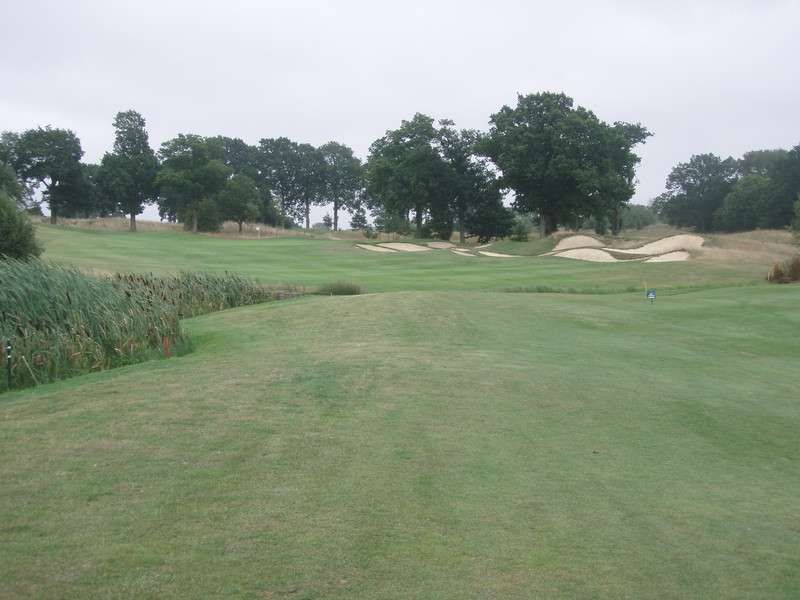
The bunker overkill can first be seen on the 2nd, that sea of sand only really likely to catch a shank

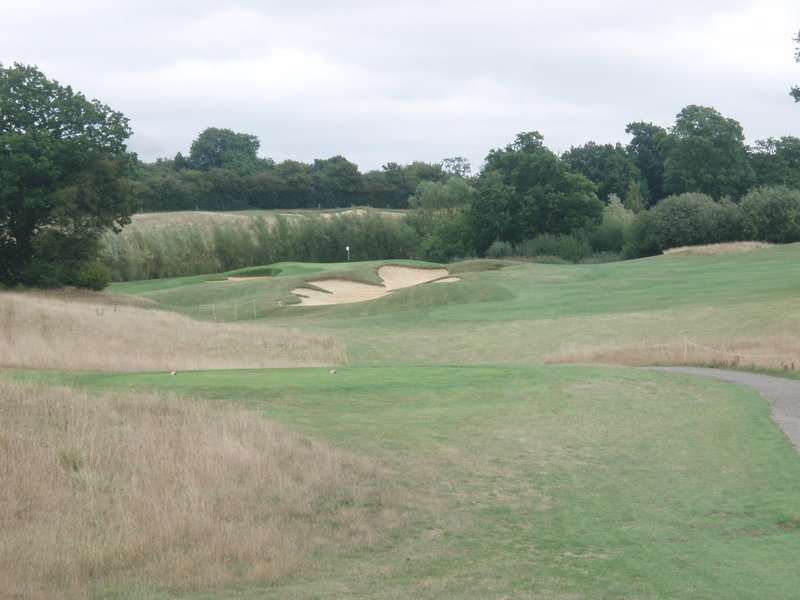
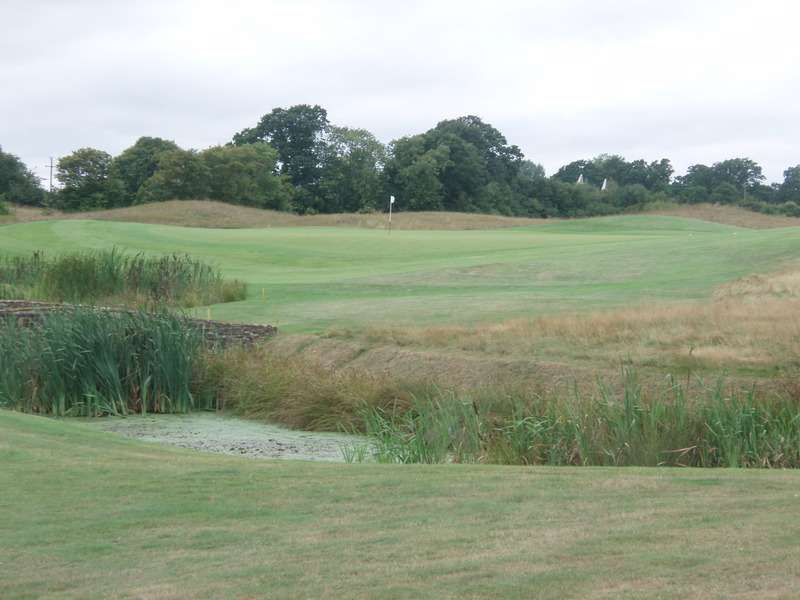
The driveable 6th combines plenty of short grass with rolling land, sand and water to create a 290-yard puzzle that can be solved many different ways

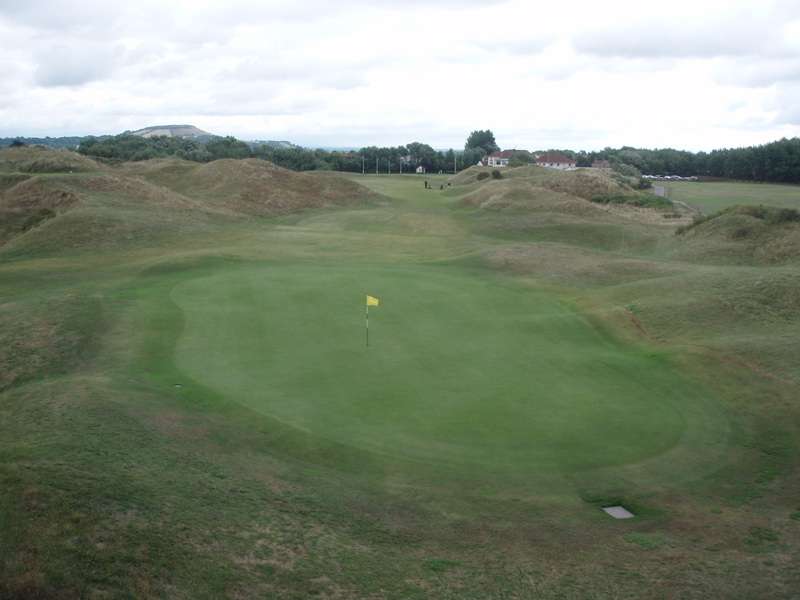
The 8th is the only bunkerless hole on the course, with a false front striking fear into you on the approach

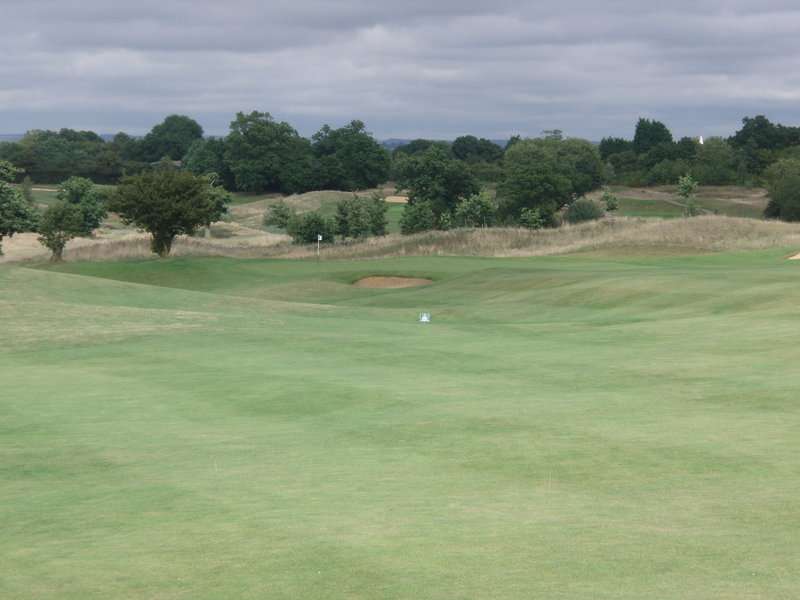
The land movement and a well-placed fronting bunker set up a Redan-inspired approach to the 10th

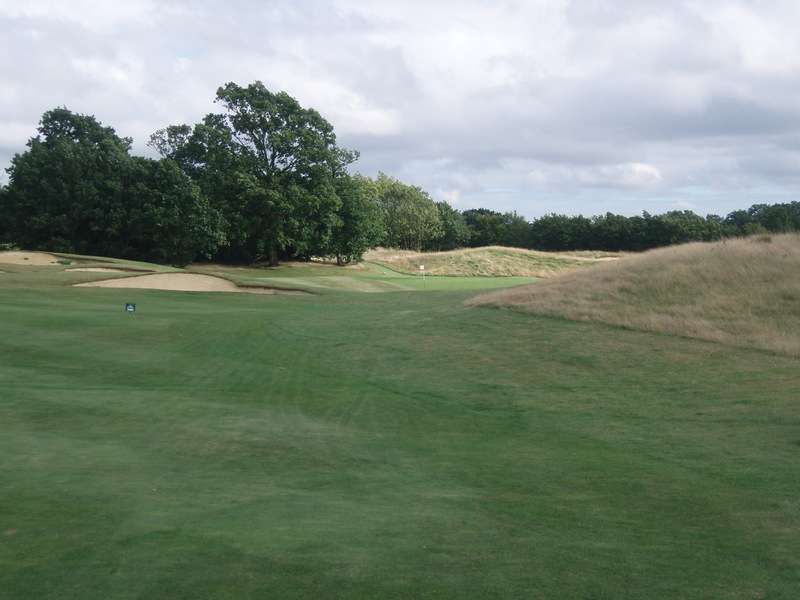
The 15th green sits semi-blind over the crest of a hill

Course name: Chart Hills
Location: Biddenden, Kent, England
Four Word Course Review: More sand than Baywatch

Florida comes to the Home Counties. This is about as un-English as you're going to get, but it's fun, there are options aplenty and ample variety.

It has somewhere in the region of 130 bunkers (the largest of which is nicknamed The Anaconda - it snakes more than 260 yards up the right of the 5th fairway, before crossing over). But for the most part they are the skeleton of some great strategy.

The sand is overpowering on a few holes - the short par four 9th and par five 16th particularly, where you can hardly see a spare square inch to hit your ball that isn't a bunker. In both instances there is enough room out there, but the landing areas are hidden from view.

The par fives particularly were a case of having to plan every shot as you plotted your route to the green.

Despite the extensive use of sand, the movement of the land is a real feature of a number of holes, creating dead ground at the 1st that foreshortens the second shot in your eye and makes it seem reachable in two, or at the driveable 6th, where the fairway bunker creates a horizon behind which the green is hidden.

Elsewhere, left of the 1st green, short of the 8th green, behind the 10th green, short and left of the 12th green are great closely mown runoffs that provide a great alternative to sand as punishment for a poorly planned or executed shot.

But there were touches of "English golf", without question.The greens are generally quite sedate and slope naturally with the surrounding land. I think that helped greatly to feel that the holes were by-and-large draped over the land - though I am sure ample earthmoving was done, it seems to have been done smartly, with long landforms that run across several holes rather than short, choppy mounds that are obviously fake. As well as that, there were very few long green to tee walks, allowing the course to flow well around the property.

Fair play to the foreign visitors who come all this way to play heathland and links golf - I can appreciate why so few schedule a game at Chart Hills. But it is a very, very good course in its own right.

Last time around Golf World had it around #80 in GB&I (down from mid-70s the time before). That seems about right to me.

Sunday, August 15, 2010

Burnham & Berrow (Championship)

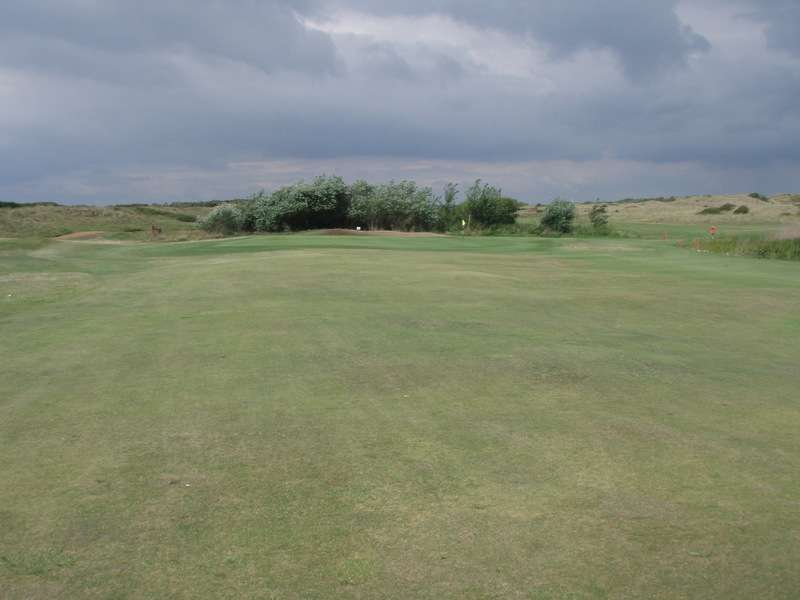
The first hole gives a good introduction to the landscape you will play through on most holes

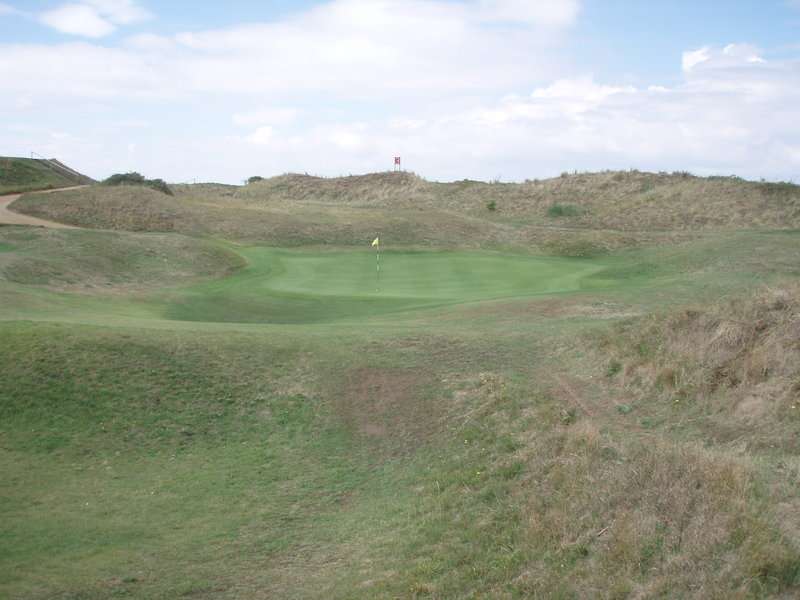
The 3rd green is set in a slight punchbowl over a series of undulations and swales

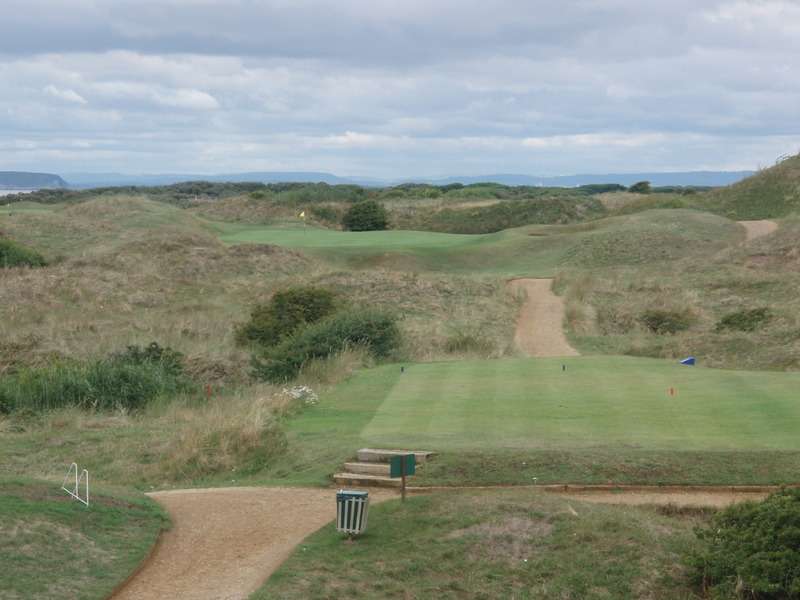
The first of the one-shotters comes at the 5th, the green surrounded by well-camouflaged bunkers

From the 6th to the 11th you play mostly through more open, flat linksland - with the par four 7th a great example of smart lay-of-the-land architecture, a central ridge dictating the strategy

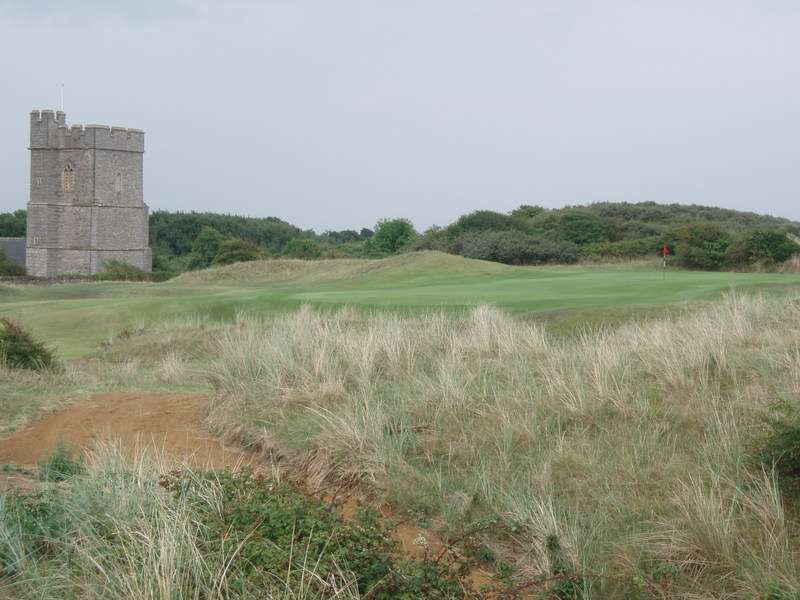
Burnham Church stands just yards from the 12th green, one of the hardest to hit on the course

The greensites don't come much better than this at the 15th, which offers plenty of ways to get home, either by air or land

The short par four 16th is slightly beyond driveable for most mortals, but that just makes the second shot - likely to be played from 30-70 yards out - all the more tricky... and fun!

Course name: Burnham & Berrow (Championship)
Location: Burnham-on-Sea, Somerset
Four Word Course Review: Thrilling routing maximises dunes

I can't remember exactly when it was that my then-girlfriend (now fiancee and within the next month my wife) and I decided that rather than just go on another holiday to Europe we would move there for a few years.
What I can recall is, the very same day we decided we were moving to London, stopping by the newsagent in my home town on Sydney's outskirts to buy a British golf magazine so I could see what awaited me.

Having selected the current edition of Golf International, I got back in my car and started to flick through. Within a few pages I came upon a double page spread - a monthly feature where Ronan Rafferty highlighted an unheralded British links. That month: Burnham & Berrow on the Atlantic coast in Somerset.

"There it is," I thought. "This is going to be amazing, all these incredible courses I have never even heard of and I'll be living within a few hours of them!"

I vowed at that moment that somehow, during my stay in the UK, I would play Burnham & Berrow.

After having several intended visits scrapped during my time here, more than two years later - closer to three, I'd say - I finally did, having made the trip down from my south London home.

The Gods clearly knew this day was special: it poured from the time I left my house at 5.30am until I met a friend at Fleet train station at 7 o'clock. It rained that soupy, annoying rain England specialises in for the two and a half hours it took us to drive from there to Burnham.

Arriving, I walked past the club notice board on my way inside the clubhouse and there it was: my article! That same spread that had excited me more than two years ago pinned between entry forms for open days and draws for club knockouts. My host told me it was a photo of the first green taken from the second tee. I resolved to get a matching photo with me in it!

It rained a constant, taunting stream as we ate breakfast in the clubhouse (food can be eaten in the bar, clubhouse rules dictate, unless the meal requires cutlery or, somewhat arbitrarily, contains chips - in which case it must be consumed in the dining room...), until, having already lingered for an extra half-hour in the hope it might clear, we made for the door to face our saturated fate.

But then, just like that, it stopped.

We played nine holes on the Channel course (nine greens, 18 tees) in completely dry weather and as we moved through the last four holes back towards the clubhouse I experienced some of the great landscape and quirk that would make the main course a highlight of my extremely fortunate portfolio of UK golfing memories.

We went inside for a pint (the local brew is called Butcombe. Careful ordering a pint of that after you've already had a few!) before tackling the main course and it returned. No sooner had glasses clinked to celebrate an enjoyable warm-up, the floor-to-ceiling windows that give those inside a perfect view of the 1st tee and 18th green told the sorry tale... the rain was back.

The pints were drained and we decided there was no delaying the inevitable. Out we headed and again the rain stopped.

From the first hole Burnham is something special, twisting and turning through the dunes with greens set at choice locations, many using the natural slopes to either feed the ball onto the green or swat it away.

While short on blindness, as is the favour post-World War Two, Burnham still manages to be quirky at ever turn, with the land making the surfeit of bunkers you see at many links wholely unnecessary.

A case in point are the two par fives on the front, which each provide brilliant interest and challenge with angled drives and greensites that sit frustratingly within reach, but of such design that hitting and holding them with a long club is just far enough beyond most golfers that you're still inclined to try, despite the expectation of almost certain failure.

Turning for home brings several holes of flatter land that give you just enough time to realise what amazing terrain you have been traversing for the past hour or two, and then you're back into it: the sensory overload of Burnham Church standing sentry by the dramatic 12th green, the narrow path of the par five 13th through the dunes, the transfixing bunkerless green on the one-shot 14th, where we spent 20 minutes putting from all corners of the putting surface, shaking our heads at the turns our balls took heading up, down and across the slopes.

The final stretch was maybe the best on the course, providing us firm ground, ample undulation and enough wind to make links shotmaking necessary.

As if to ice the cake, I chipped from a rough-covered ridge 50 yards short of the 18th green to within a foot to secure my par. My friend matched me by holing a 40-footer. The day was just as special for him: he has been visiting Burnham regularly (but not regularly enough, I'm sure) since he was 11. Our host made it three pars for the group by tapping in a three-footer that we would have conceded were we better guests!

I arrived home close to 19 hours after I had departed, exhausted but elated. Birdie or bogey, the smile hadn't left my face all day. I had realised a dream that evolved almost 20,000km away.
Monday, August 09, 2010

Worplesdon

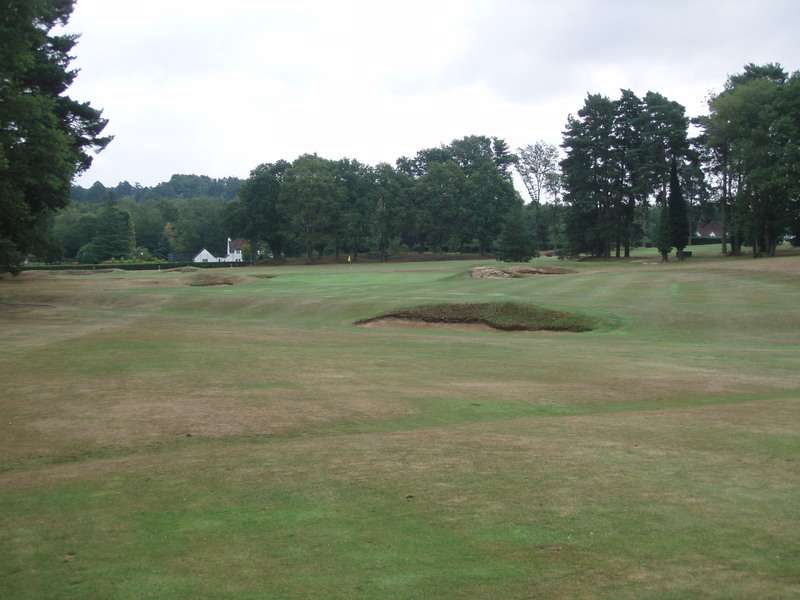
The distance to the pin on the third is hard to judge with no landmarks close to the back of the green

Looking back to the tee at the long uphil par three 4th
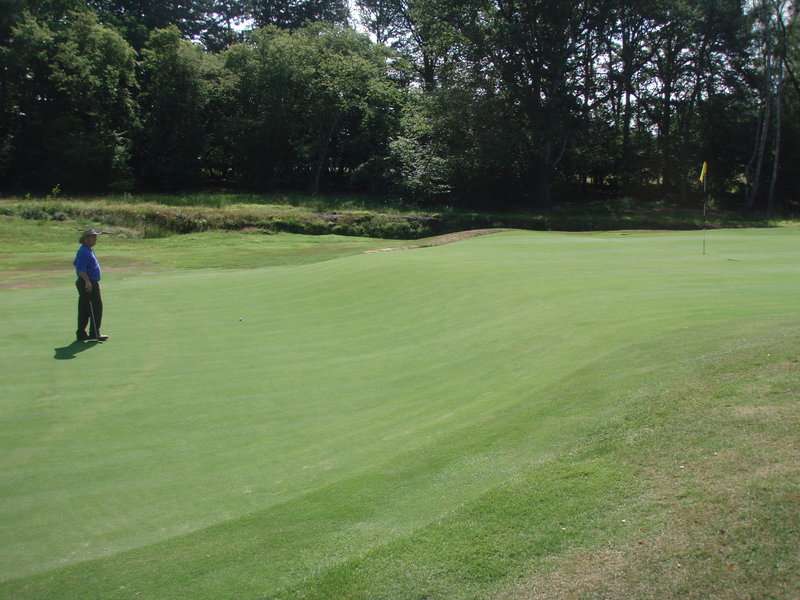
The golfer pictured isn't a short man - the difference between the height of the two tiers at the par four 8th is just that great

The water carry par three 10th - with so many great holes at Worplesdon it's amazing the club parades this on its website and in its yardage book as the course's "signature hole"

The approach to the par five 12th is best played from the left to a well-guarded green that slopes more from back to front than it first appears

The par three 13th offers nowhere pleasant to miss, with plenty of space around the green allowing the bunkers to dominate the vista

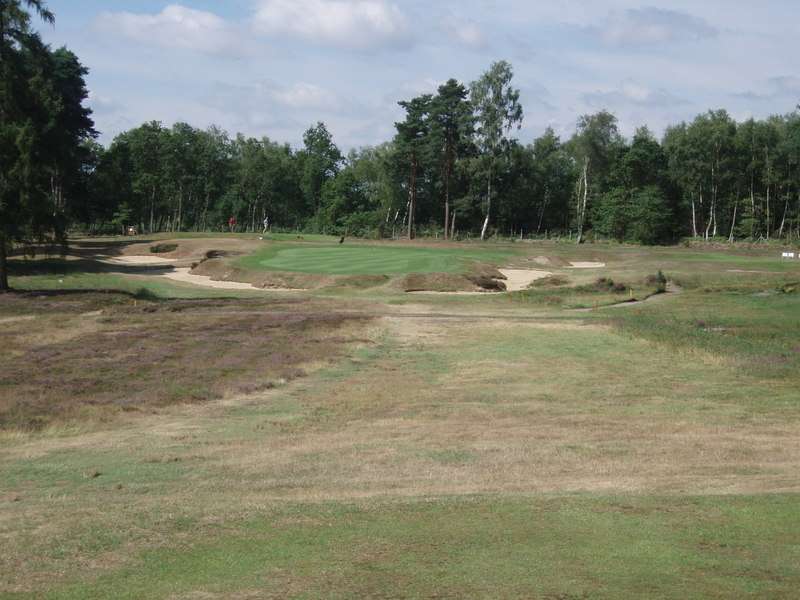
The two menacing bunkers at the 16th hide the fact there is a lot of space on and around the green

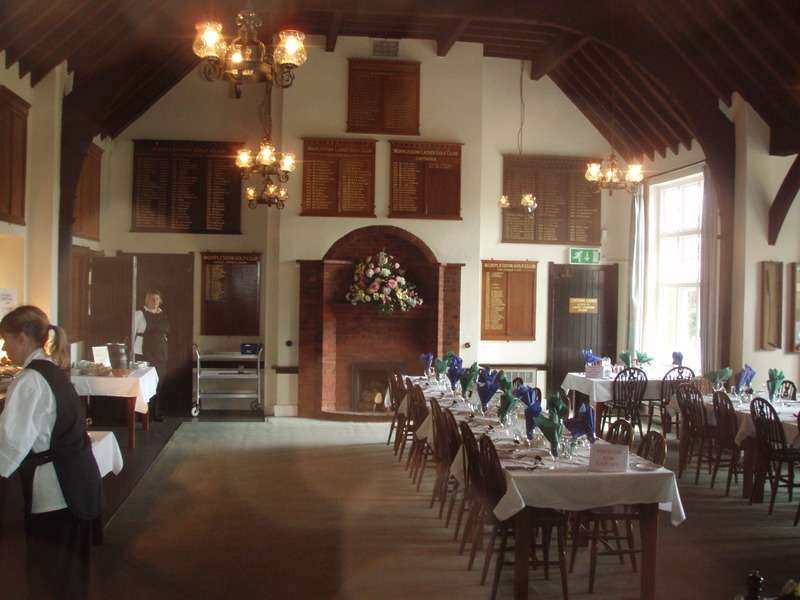
Time for lunch: the cornerstone of a 36-hole day at any self-respecting English golf club!

Course name: Worplesdon
Location: Woking, Surrey
Four Word Course Review: Fantastic fives and threes

Gunfire. Is there a more horrible noise known to man? Perhaps only the rock band Evanescence and my boss bellowing my name in a way that tells me I am about to regret the day I was born can compare for sheer irritation and aggravation.

Constant gunfire in the field that adjoins Worplesdon Golf Club had me checking as I played the back nine that I hadn't been transported back in time to enjoy a round at Somme Valley GC in the summer of 1916.

It's an example of the way outside influences can affect a round of golf, but when the golf is as good as it is at Worplesdon, it would take a lot more than a field full of trigger-happy shooters to ruin your day. Unless one of them missed a clay pigeon and picked you off as you walked off the neighbouring 14th tee...

Worplesdon has a challenging and memorable set of par fives and par threes (four three-shotters and five one-shotters) that are threaded together by nine par fours that offer compelling golf in their own right.

Perhaps the best holes of each par come in a three-hole stretch on the back nine where the strategic, brilliantly-bunkered par five 12th is followed by a long iron par three to a green surrounded by sand and a long uphill two-shotter boasting even more smart bunkering on both the drive and approach.

It's no accident that hazard placement is a highlight of arguably the three best holes, it consistantly lifts the standard of the holes from very good to great, working in tandem with rollicking land that rarely runs flat for long.

Bold greens star at the 7th, 8th and 17th - all two-tiered efforts where the back is much, much higher than the front, making it almost impossible to lag close if putting from one tier to the other.

The 8th might be the best example of the three, with a steep drop-off at the back making distance control essential if you want to avoid a fate much worse than a putt up to the top tier, and what's more your approach is downhill and likely to be played with a mid iron or short iron, making a running approach that much more difficult to execute.

Also worthy of note are the rollercoaster par five 11th, with its wonderful angled green and bookend bunkers, the long-uphill par three 16th, defended short by two deep heather-faced traps (from which I am sure very few pars are made) and the confounding 5th, which calls for a diagonal drive over heather that has to squeeze between the purple sea and a bunker if you want to shorten the approach to the front-to-back tiered green that is made more difficult to hit thanks to two swales that front the putting surface.

Blind shots are not shied away from, with the tee shots at the 2nd, 8th, 15th and 18th and second shots at the 6th and 11th played blind over the dramatic heather-laced landscape. There isn't a single example that feels forced or contrived.

Contrived... now that is a term I would reserve for the mid-length par three over a lake that seems as regular at heathland golf courses as it is incongruous with the surrounds. Woking (16th), Worplesdon (10th) and West Sussex (15th) each have such a hole and I am yet to see the concept add to the course.

If such a hole has to be built, I'd rather see the green hard up against the water to give the hazard more purpose. But that is a small quibble when measured up against the great holes either side of it that make this course such fun to play.

One last thing to note is the quite unique bunker faces, compared to the rest of the heathland. They're quite striking, yet simple and seem to suit the course.

Just another brilliant heathland gem, then! I hope the people of Surrey and Berkshire appreciate the embarrassment of riches that surrounds them.